nvx
Cross-Platform Micro-VM Sandbox for Agentic Workloads
Runs with mockssource: GitHubRustMITcommit 5b37b4f159ad
Rust, MIT licensed. The project labels itself: agentic coding, agentic engineering, agentic workflows, hyperv, hypervisor, kvm, linux and microvm.
nvx runs, with stand-ins for the services it depends on. An Argusic agent installed it in 70 minutes and hit 7 errors and fixed every one without help on a clean machine with no GPU, and the whole session was recorded.
Dependencies installed in a venv and the release bundle downloaded/verified; the Python tooling test suite passes (454 tests), OpenVMM runs its 4562-test unit suite with only the container's NUMA-seccomp-blocked mbind tests failing, the openvmm binary answers version/help, and the kernel plus all three initramfs images and the erofs layer decode as valid media;
What the agent ended up with on a clean machine, in its own words. How this is measured
Measured by Argusic on a fresh machine every time. Every number links to its evidence. Argusic Score 86 of 100 (the mean of this project's run scores).
At a glance
Subject data from GitHub, linked at the top of this page, refreshed . Test data by Argusic (CC BY 4.0); every number links to a run page with the full log, the recording, and their sha256 hashes.
What was measured
From the run that decided this verdict. Every line is a recorded value, not an estimate.
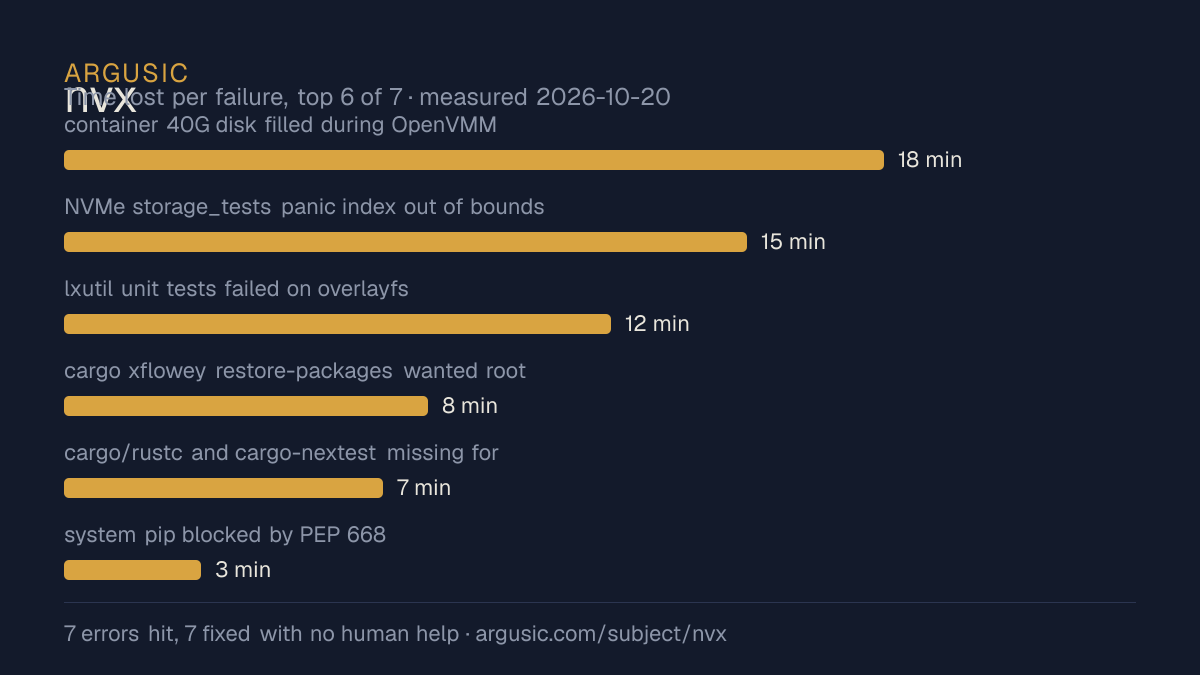
What went wrong, in the agent's own words
The agent's own words, worst first, never rewritten into advice.
- container 40G disk filled during OpenVMM debug build (linker SIGBUS then ENOSPC)18 minutes
- NVMe storage_tests panic index out of bounds len 64 when thread lands on host cpu 71/147/167 (container cpuset), sparse_mmap NUMA mbind EPERM via seccomp15 minutes
- lxutil unit tests failed on overlayfs: 1024-byte symlink target hits ENAMETOOLONG (max 1023), and rename inode assertion 17!=3912 minutes
- cargo xflowey restore-packages wanted root apt for git/libarchive-tools and bsdtar8 minutes
- cargo/rustc and cargo-nextest missing for OpenVMM unit tests7 minutes
- system pip blocked by PEP 668 externally-managed environment3 minutes
- Install time
- 70 minutes
- Cold machine to finish
- 78 minutes
- Errors hit and fixed
- 7 hit, 7 fixed with no human help
- How the result was proved
- python -m unittest scripts.test_performance scripts.test_nvx_tools scripts.test_microvm_tests scripts.test_development_release exited 0 (454 tests, OK, 7 skipped); openvmm --version printed 'openvmm 0.2.0+gd0bdbed8f'; nvx.py run --dry-run printed the openvmm command; cargo nextest run (agent profile, --features ci) executed 4562 tests with 4560 passing, 2 failing (NUMA seccomp), 10 skipped; nvx.py download exited 0; gzip/cpio/ELF/erofs decodes of build artifacts all parsed
- Model tokens used
- 6,822,191
- Exact commit tested
- 5b37b4f159ad
- Container image
- sha256:cdd920bce783
What was not measured
The other half, so you can see exactly how far this evidence goes. A gap is printed as a gap and never filled in.
- Peak GPU memory
- this ran on a CPU machine, so there was no GPU to sample
- Behaviour over a long run
- each attempt uses the smallest documented settings and a fixed time budget, so this measures whether it runs, not how it holds up under load
- Behaviour against real services
- this run was verified against stand-in services only
Watch the session
The whole run, from a clean machine, at the speed it actually happened. Nothing is cut and nothing is sped up.
A recording of attempt 1, run , the attempt that decided the verdict above. The terminal recording it was made from is the evidence, stored with a sha256 fingerprint; the video is a rendering of it. Nothing loads from the video host until you press play.
The end of the recording
The last lines of the terminal session that decided this verdict, exactly as they were recorded.
    {"msg": "microVM guest boot cannot run: no /dev/kvm or /dev/mshv in container and this OpenVMM …
  ],
  "test_depth": "tier2_mock",
  "notes": "No third-party keys required. Python unit suite fully green (454 tests, 7 Windows-only …
  "verified_how": "python -m unittest scripts.test_performance scripts.test_nvx_tools scripts.test_…
  \"final_state\": \"Dependencies installed in a venv and the release bundle downloaded/verified; t…
}
print(\"ARGUSIC_RESULT:\" + json.dumps(report))
EOF" in /work/repo
 succeeded in 0ms:
tokens used
6,822,191
Replay the whole session, every command from a clean machine to this point.
How it was tested
One agent, one container, no human help. It installs the project the way its own documentation says to, runs it, and fixes what breaks. Everything below is recorded as it happened: the terminal session, the log and the exact commit. The full method.
Strengths and limits
Measured facts, not opinions. How this is written.
What went well
- Recovered from all 7 errors without a human stepping in, which says the failures are documented well enough to solve.
- Licensed MIT, as reported by its host.
- Measured 2 times, so the result is not a one-off.
What did not, or is not known
- Only reached a running state against stand-in services, so nothing here proves it works against the real ones.
- Took 70 minutes to install, slower than the median of the 29 comparable projects Argusic has measured.
Of the 30 agentic-coding projects Argusic has installed and timed, nvx was the 30th fastest to reach a running state, and 23 of 30 reached one at all.
Also tested, in the same area
Every one of these was installed and run by Argusic on a clean machine. Nothing appears here that was not tested.
Run history
| tested by | attempt | outcome | score | cost USD | when |
|---|---|---|---|---|---|
| Argusic Runner | 2/3 | Unverified | 80.00 | 0.05 | |
| Argusic Runner | 1/3 | Runs with mocks | 92.00 | 1.48 |
Topics (from GitHub)
agentic-codingagentic-engineeringagentic-workflowshypervhypervisorkvmlinuxmicrovmsandboxvm
Embed the badge
Markdown for the project README. It links back here; terms on the terms page.
[](https://argusic.com/subject/nvx)Questions
- Does nvx run?
- nvx runs, with mocks standing in for external services. Argusic installed and launched it on a clean machine in 70 minutes, hitting 7 errors on the way, and recorded the session.
- How did Argusic test nvx?
- On a fresh, disposable machine, with every command recorded and the repository pinned at commit 5b37b4f159ad. 2 attempts are recorded, and the full method is on the methodology page.
- What did it cost to test nvx?
- The run that produced this verdict cost $1.48: real compute and model cost, not a list price per million tokens. It is recorded on that run's page.
- How long does nvx take to install?
- 70 minutes in the run that decided this verdict, from a clean machine to a running state. That is one measured attempt, not an average.
- Does nvx need a GPU?
- Not to start. Argusic reached a running state on a machine with no GPU.
- What goes wrong when installing nvx?
- 7 things broke in the recorded run, and 7 were fixed without human help. Each one, and the time it cost, is listed on this page.
- How does nvx compare with the alternatives?
- Of the 30 agentic-coding projects Argusic has installed and timed, nvx was the 30th fastest to reach a running state, and 23 of 30 reached one at all.
- Where is the evidence for nvx?
- All 2 recorded runs are on this page, each linking to its full log and terminal recording, stored with a sha256 fingerprint so it cannot be quietly altered.