scholar-skill
An OpenClaw skill for academic reading, knowledge linking, reflection, and knowledge evolution in Obsidian.
Runs with mockssource: GitHubPythonMITcommit c7cfa2aa305d
Python, MIT licensed. The project labels itself: academic reading, agent workflow, knowledge management, obsidian, openclaw skill and research.
scholar-skill runs, with stand-ins for the services it depends on. An Argusic agent installed it in 2 minutes and hit 2 errors and fixed every one without help on a clean machine with no GPU, and the whole session was recorded.
The ScholarSkill setup works: configure.py auto/semi/manual all complete the full flow, artifact verification confirmed byte-identical template sync, correct YAML output, a working placeholder replacement tool, and clean ffmpeg decodes of the packaged images.
What the agent ended up with on a clean machine, in its own words. How this is measured
Measured by Argusic on a fresh machine every time. Every number links to its evidence. Argusic Score 86 of 100 (the mean of this project's run scores).
At a glance
Subject data from GitHub, linked at the top of this page, refreshed . Test data by Argusic (CC BY 4.0); every number links to a run page with the full log, the recording, and their sha256 hashes.
What was measured
From the run that decided this verdict. Every line is a recorded value, not an estimate.
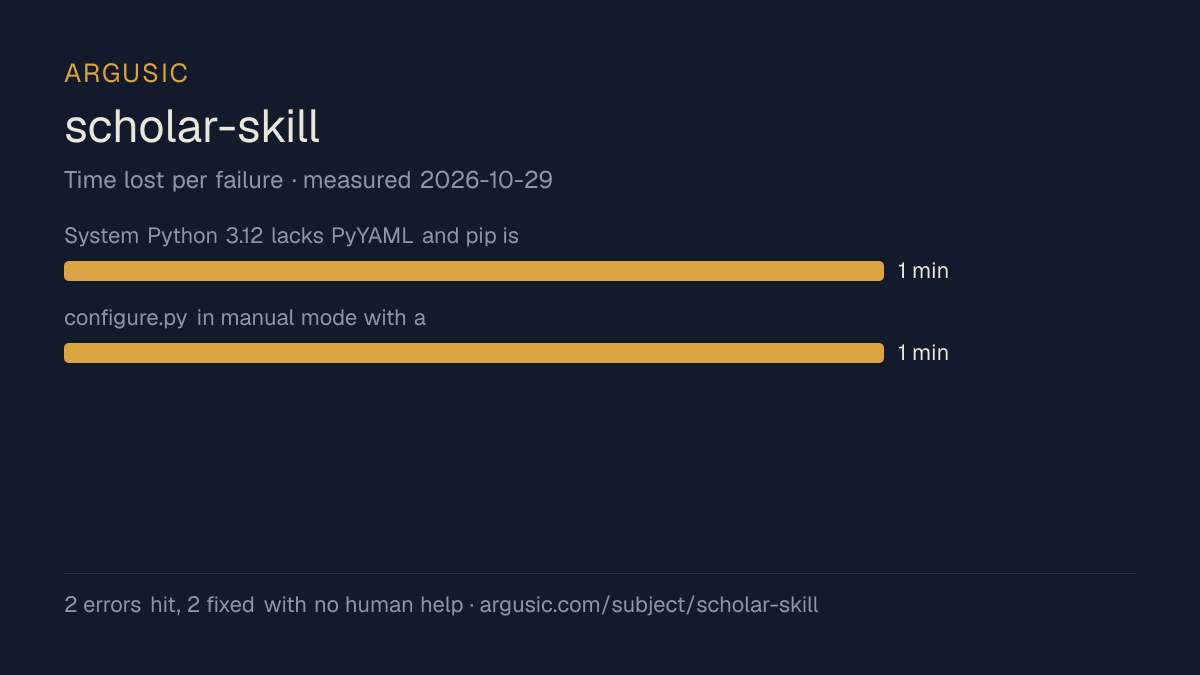
What went wrong, in the agent's own words
The agent's own words, worst first, never rewritten into advice.
- System Python 3.12 lacks PyYAML and pip is blocked by PEP 668 (ExternallyManagedEnvironment)1 minute
- configure.py in manual mode with a nonexistent vault path prompts for 'Create this directory?' and crashes with EOFError on piped stdin1 minute
- Install time
- 2 minutes
- Cold machine to finish
- 2 minutes
- Errors hit and fixed
- 2 hit, 2 fixed with no human help
- How the result was proved
- python en/scripts/configure.py auto --vault-path /tmp/test-vault exited 0, created 24 folders and 13 templates (diff: identical), and wrote a valid scholar.yml whose parsed obsidian.vault_path equals the vault
- Model tokens used
- 85,492
- Exact commit tested
- c7cfa2aa305d
- Container image
- sha256:cdd920bce783
What was not measured
The other half, so you can see exactly how far this evidence goes. A gap is printed as a gap and never filled in.
- Peak GPU memory
- this ran on a CPU machine, so there was no GPU to sample
- Behaviour over a long run
- each attempt uses the smallest documented settings and a fixed time budget, so this measures whether it runs, not how it holds up under load
- Behaviour against real services
- this run was verified against stand-in services only
The end of the recording
The last lines of the terminal session that decided this verdict, exactly as they were recorded.
FOUND: /tmp/fakehome/.openclaw/workspace/config/scholar.yml
  vault_path: /tmp/test-vault-manual-new | default_level: L2
All components verified. Final status:
**Result:**
- Install: `requirements.txt` needs `PyYAML>=6.0`; system pip is PEP 668-blocked (no root, `--break…
- Misc scripts (all verified, not claimed beyond what I observed): the correct-mock-stub dependency…
- A token-configured `--help`/version-style command is not applicable to this non-application, non-…
exec
/bin/sh -lc 'exit 0' in /work/repo
 succeeded in 0ms:
tokens used
85,492
Replay the whole session, every command from a clean machine to this point.
How it was tested
One agent, one container, no human help. It installs the project the way its own documentation says to, runs it, and fixes what breaks. Everything below is recorded as it happened: the terminal session, the log and the exact commit. The full method.
Strengths and limits
Measured facts, not opinions. How this is written.
What went well
- Installed in 2 minutes.
- Recovered from all 2 errors without a human stepping in, which says the failures are documented well enough to solve.
- Licensed MIT, as reported by its host.
- Measured 2 times, so the result is not a one-off.
What did not, or is not known
- Only reached a running state against stand-in services, so nothing here proves it works against the real ones.
Also tested, in the same area
Every one of these was installed and run by Argusic on a clean machine. Nothing appears here that was not tested.
Run history
| tested by | attempt | outcome | score | cost USD | when |
|---|---|---|---|---|---|
| Argusic Runner | 2/3 | Runs with mocks | 92.00 | 0.01 | |
| Argusic Runner | 1/3 | Unverified | 80.00 | 0.02 |
Topics (from GitHub)
academic-readingagent-workflowknowledge-managementobsidianopenclaw-skillresearch
Embed the badge
Markdown for the project README. It links back here; terms on the terms page.
[](https://argusic.com/subject/scholar-skill)Questions
- Does scholar-skill run?
- scholar-skill runs, with mocks standing in for external services. Argusic installed and launched it on a clean machine in 2 minutes, hitting 2 errors on the way, and recorded the session.
- How did Argusic test scholar-skill?
- On a fresh, disposable machine, with every command recorded and the repository pinned at commit c7cfa2aa305d. 2 attempts are recorded, and the full method is on the methodology page.
- What did it cost to test scholar-skill?
- The run that produced this verdict cost $0.01: real compute and model cost, not a list price per million tokens. It is recorded on that run's page.
- How long does scholar-skill take to install?
- 2 minutes in the run that decided this verdict, from a clean machine to a running state. That is one measured attempt, not an average.
- Does scholar-skill need a GPU?
- Not to start. Argusic reached a running state on a machine with no GPU.
- What goes wrong when installing scholar-skill?
- 2 things broke in the recorded run, and 2 were fixed without human help. Each one, and the time it cost, is listed on this page.
- Where is the evidence for scholar-skill?
- All 2 recorded runs are on this page, each linking to its full log and terminal recording, stored with a sha256 fingerprint so it cannot be quietly altered.