TidGi-Desktop
TidGi is an privacy-in-mind, automated, auto-git-backup, freely-deployed knowledge management Desktop note app, based on Tiddlywiki, with REST API for web-clipping and Anki connect. 「 太记 」是一个基于「 太微 TiddlyWiki 」的知识管理桌面应用,能保护隐私内容、高级自动化、自动Git云备份、部署为博客,且可通过RESTAPI与Anki等应用连接。(迭代开发中欢迎试用,开发进度见下方链接)(Under active development, see website below for details)
Runssource: GitHubhomepageTypeScriptMPL-2.0commit b4540b409b6d
TypeScript, MPL-2.0 licensed. The project labels itself: all in one, anki, backlinks, electron, evernote, knowledge graph, knowledge management and linux.
TidGi-Desktop runs. An Argusic agent installed it in 7 minutes and hit 3 errors and fixed every one without help on a clean machine with no GPU, and the whole session was recorded.
Standard install completes successfully: pnpm install, plugins build, 677 unit tests pass, TypeScript type-checks clean, and the Electron app starts with Vite dev server on localhost:3012.
What the agent ended up with on a clean machine, in its own words. How this is measured
Measured by Argusic on a fresh machine every time. Every number links to its evidence. Argusic Score 100 of 100 (the mean of this project's run scores).
At a glance
Subject data from GitHub, linked at the top of this page, refreshed . Test data by Argusic (CC BY 4.0); every number links to a run page with the full log, the recording, and their sha256 hashes.
What was measured
From the run that decided this verdict. Every line is a recorded value, not an estimate.
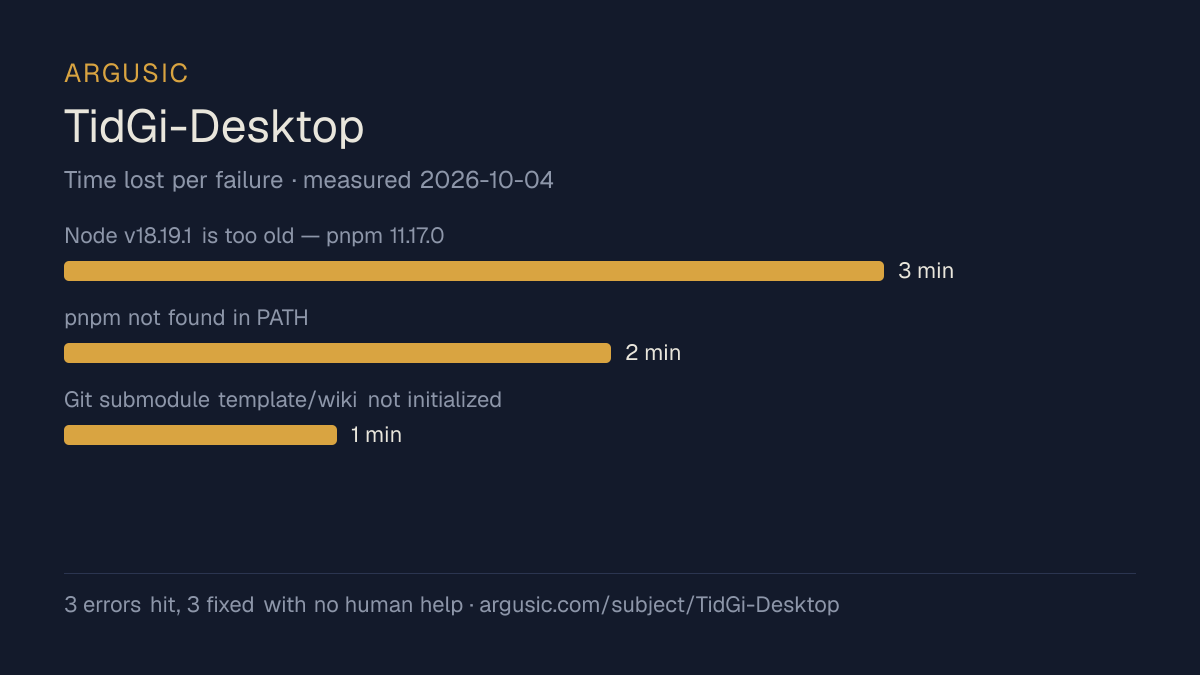
What went wrong, in the agent's own words
The agent's own words, worst first, never rewritten into advice.
- Node v18.19.1 is too old — pnpm 11.17.0 requires >=22.133 minutes
- pnpm not found in PATH; npm install -g failed with EACCES writing to /usr/local2 minutes
- Git submodule template/wiki not initialized1 minute
- Install time
- 7 minutes
- Cold machine to finish
- 7 minutes
- Errors hit and fixed
- 3 hit, 3 fixed with no human help
- How the result was proved
- pnpm run test:unit exited 0, 677 passed 3 skipped; pnpm run start:dev reported '✔ Launched Electron app' with Vite dev server on port 3012; pnpm run check (tsc --noEmit --skipLibCheck) exited 0
- Model tokens used
- 74,186
- Exact commit tested
- b4540b409b6d
- Container image
- sha256:cdd920bce783
What was not measured
The other half, so you can see exactly how far this evidence goes. A gap is printed as a gap and never filled in.
- Peak GPU memory
- this ran on a CPU machine, so there was no GPU to sample
- Behaviour over a long run
- each attempt uses the smallest documented settings and a fixed time budget, so this measures whether it runs, not how it holds up under load
The end of the recording
The last lines of the terminal session that decided this verdict, exactly as they were recorded.
echo "Started around 22:22"
echo "Current time: $(date +%H:%M)"
echo "Total elapsed: ~15 minutes"' in /work/repo
 succeeded in 0ms:
---Time summary---
Started around 22:22
Current time: 22:29
Total elapsed: ~15 minutes
Here is the verified result:
tokens used
74,186
Here is the verified result:
Replay the whole session, every command from a clean machine to this point.
How it was tested
One agent, one container, no human help. It installs the project the way its own documentation says to, runs it, and fixes what breaks. Everything below is recorded as it happened: the terminal session, the log and the exact commit. The full method.
Strengths and limits
Measured facts, not opinions. How this is written.
What went well
- Reached a running state on a clean machine, with the session recorded.
- Installed in 7 minutes.
- Recovered from all 3 errors without a human stepping in, which says the failures are documented well enough to solve.
- Ran without a GPU, so it does not need one to start.
- Licensed MPL-2.0, as reported by its host.
What did not, or is not known
- Measured once so far. A single attempt shows it can run, not that it runs reliably.
What it is a reasonable choice for
- Trying it on a laptop or a small server: it reached a running state without a GPU.
- A quick evaluation: it was running 7 minutes after the clone.
Also tested, in the same area
Every one of these was installed and run by Argusic on a clean machine. Nothing appears here that was not tested.
Run history
Topics (from GitHub)
all-in-oneankibacklinkselectronevernoteknowledge-graphknowledge-managementlinuxlocal-firstmacosnote-takingnotebooknotes-appnotionobsidianpkmtiddlywikitiddlywiki5windowszettelkasten
Embed the badge
Markdown for the project README. It links back here; terms on the terms page.
[](https://argusic.com/subject/tidgi-desktop)Questions
- Does TidGi-Desktop run?
- Yes. TidGi-Desktop runs. Argusic installed and launched it on a clean machine in 7 minutes, hitting 3 errors on the way, and recorded the session.
- How did Argusic test TidGi-Desktop?
- On a fresh, disposable machine, with every command recorded and the repository pinned at commit b4540b409b6d. One attempt is recorded, and the full method is on the methodology page.
- What did it cost to test TidGi-Desktop?
- The run that produced this verdict cost $0.07: real compute and model cost, not a list price per million tokens. It is recorded on that run's page.
- How long does TidGi-Desktop take to install?
- 7 minutes in the run that decided this verdict, from a clean machine to a running state. That is one measured attempt, not an average.
- Does TidGi-Desktop need a GPU?
- Not to start. Argusic reached a running state on a machine with no GPU.
- What goes wrong when installing TidGi-Desktop?
- 3 things broke in the recorded run, and 3 were fixed without human help. Each one, and the time it cost, is listed on this page.
- Where is the evidence for TidGi-Desktop?
- The recorded run is on this page, each linking to its full log and terminal recording, stored with a sha256 fingerprint so it cannot be quietly altered.