walrus
🦭 Distributed log streaming engine built from first principles
Runssource: GitHubhomepageRustMITcommit 89a38a0b6dd0
Rust, MIT licensed. The project labels itself: apache kafka, database, kafka, nats, redpanda, rust, storage engine and stream processing.
walrus runs. An Argusic agent installed it in 30 minutes and hit 5 errors on a clean machine with no GPU, and the whole session was recorded.
A 3-node Walrus cluster runs with Raft consensus (node 1 Leader, nodes 2 and 3 Followers), all three nodes accept topic registration and message put/get operations, with full 3-node membership in Raft metrics.
What the agent ended up with on a clean machine, in its own words. How this is measured
Measured by Argusic on a fresh machine every time. Every number links to its evidence. Argusic Score 96 of 100 (the mean of this project's run scores).
At a glance
Subject data from GitHub, linked at the top of this page, refreshed . Test data by Argusic (CC BY 4.0); every number links to a run page with the full log, the recording, and their sha256 hashes.
What was measured
From the run that decided this verdict. Every line is a recorded value, not an estimate.
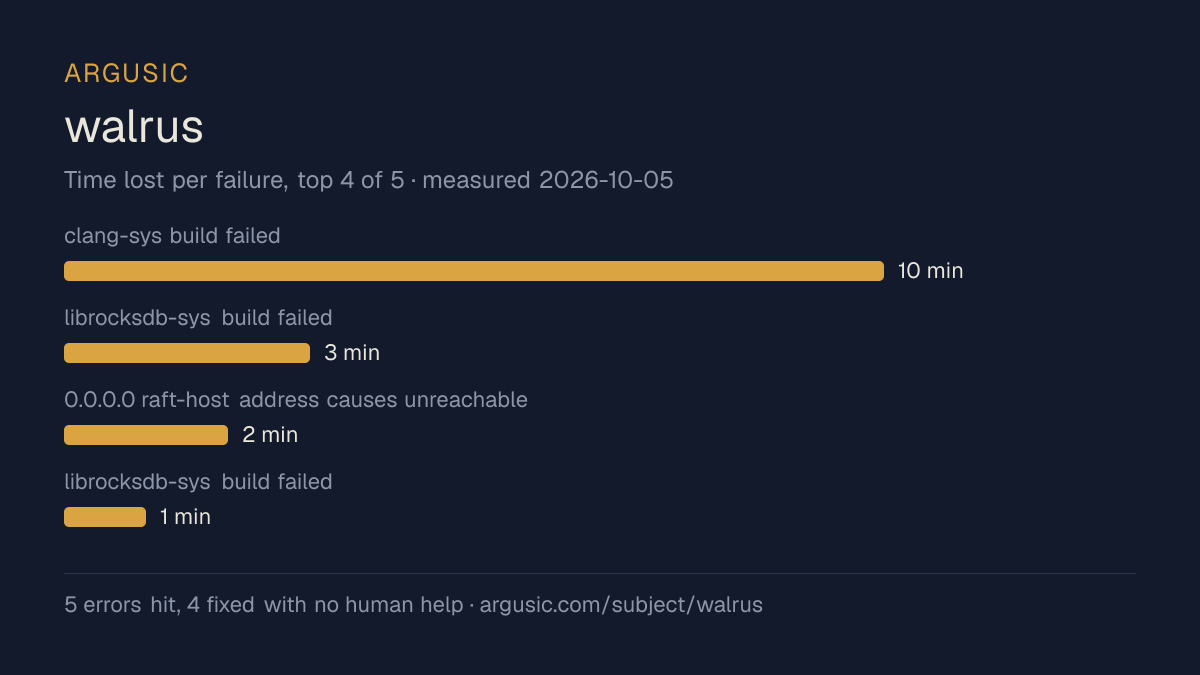
What went wrong, in the agent's own words
The agent's own words, worst first, never rewritten into advice.
- clang-sys build failed: missing libclang.so for rocksdb bindgen10 minutes
- librocksdb-sys build failed: stdbool.h not found by clang3 minutes
- 0.0.0.0 raft-host address causes unreachable peers in Raft replication2 minutes
- librocksdb-sys build failed: cannot load libclang-20.so.20 shared library1 minute
- test_env_var_race_condition test panics reproducing a known env-var race
- Install time
- 30 minutes
- Cold machine to finish
- 64 minutes
- Errors hit and fixed
- 5 hit, 4 fixed with no human help
- How the result was proved
- walrus-cli --addr 127.0.0.1:9091 register/put/get returned OK on all 3 cluster nodes; walrus-cli --version printed distributed-walrus 0.1.0; cargo test for walrus-rust: 142/145 passed; cargo test for distributed-walrus: 3/3 passed
- Model tokens used
- 378,410
- Exact commit tested
- 89a38a0b6dd0
- Container image
- sha256:cdd920bce783
What was not measured
The other half, so you can see exactly how far this evidence goes. A gap is printed as a gap and never filled in.
- Peak GPU memory
- this ran on a CPU machine, so there was no GPU to sample
- Behaviour over a long run
- each attempt uses the smallest documented settings and a fixed time budget, so this measures whether it runs, not how it holds up under load
The end of the recording
The last lines of the terminal session that decided this verdict, exactly as they were recorded.
exec
/bin/sh -lc '. "$HOME/.cargo/env" && cd /work/repo && cargo test --test unit 2>&1 | grep "test resu…
 exited 1 in 3831ms:
exec
/bin/sh -lc '. "$HOME/.cargo/env" && cd /work/repo && export LIBCLANG_PATH=/tmp/libclang/usr/lib/ll…
The unit test suite takes a while (280s for the 36 tests). Let me wait for it to complete:
 succeeded in 713662ms:
test result: ok. 36 passed; 0 failed; 0 ignored; 0 measured; 0 filtered out; finished in 277.85s
Unit tests still pass. Now let me write the final report.
tokens used
378,410
Unit tests still pass. Now let me write the final report.
Replay the whole session, every command from a clean machine to this point.
How it was tested
One agent, one container, no human help. It installs the project the way its own documentation says to, runs it, and fixes what breaks. Everything below is recorded as it happened: the terminal session, the log and the exact commit. The full method.
Strengths and limits
Measured facts, not opinions. How this is written.
What went well
- Reached a running state on a clean machine, with the session recorded.
- Installed in 30 minutes.
- Ran without a GPU, so it does not need one to start.
- Licensed MIT, as reported by its host.
What did not, or is not known
- Hit 5 errors during setup, 1 of which were not solved.
- Measured once so far. A single attempt shows it can run, not that it runs reliably.
What it is a reasonable choice for
- Trying it on a laptop or a small server: it reached a running state without a GPU.
Also tested, in the same area
Every one of these was installed and run by Argusic on a clean machine. Nothing appears here that was not tested.
Run history
Topics (from GitHub)
apache-kafkadatabasekafkanatsredpandaruststorage-enginestream-processingstreams
Embed the badge
Markdown for the project README. It links back here; terms on the terms page.
[](https://argusic.com/subject/walrus)Questions
- Does walrus run?
- Yes. walrus runs. Argusic installed and launched it on a clean machine in 30 minutes, hitting 5 errors on the way, and recorded the session.
- How did Argusic test walrus?
- On a fresh, disposable machine, with every command recorded and the repository pinned at commit 89a38a0b6dd0. One attempt is recorded, and the full method is on the methodology page.
- What did it cost to test walrus?
- The run that produced this verdict cost $0.32: real compute and model cost, not a list price per million tokens. It is recorded on that run's page.
- How long does walrus take to install?
- 30 minutes in the run that decided this verdict, from a clean machine to a running state. That is one measured attempt, not an average.
- Does walrus need a GPU?
- Not to start. Argusic reached a running state on a machine with no GPU.
- What goes wrong when installing walrus?
- 5 things broke in the recorded run, and 4 were fixed without human help. Each one, and the time it cost, is listed on this page.
- Where is the evidence for walrus?
- The recorded run is on this page, each linking to its full log and terminal recording, stored with a sha256 fingerprint so it cannot be quietly altered.