second-brain
Second Brain is an agentic framework that acts as an operating system, using local file intelligence, workflow automation, and LLMs to complete tasks and communicate over multiple modalities and messaging platforms.
Runssource: GitHubPythonMITcommit d79ca2e1859a
Python, MIT licensed. The project labels itself: agentic ai, agentic workflow, ai, ai agent tools, ai agents, cronjob scheduler, data science and database.
second-brain runs. An Argusic agent installed it in 51 minutes and hit 5 errors on a clean machine with no GPU, and the whole session was recorded.
Second Brain Python kernel installed and starts. HTTP frontend serves port 8789 and responds to authenticated SDK requests. Web UI builds with Node 22. Test suite runs 2819 passing tests with 2 pre-existing failures. Requires Node 20.19+ or 22.12+ for the web UI; port 8787 is blocked by an orphaned socket from prior test runs.
What the agent ended up with on a clean machine, in its own words. How this is measured
Measured by Argusic on a fresh machine every time. Every number links to its evidence. Argusic Score 96 of 100 (the mean of this project's run scores).
At a glance
Subject data from GitHub, linked at the top of this page, refreshed . Test data by Argusic (CC BY 4.0); every number links to a run page with the full log, the recording, and their sha256 hashes.
What was measured
From the run that decided this verdict. Every line is a recorded value, not an estimate.
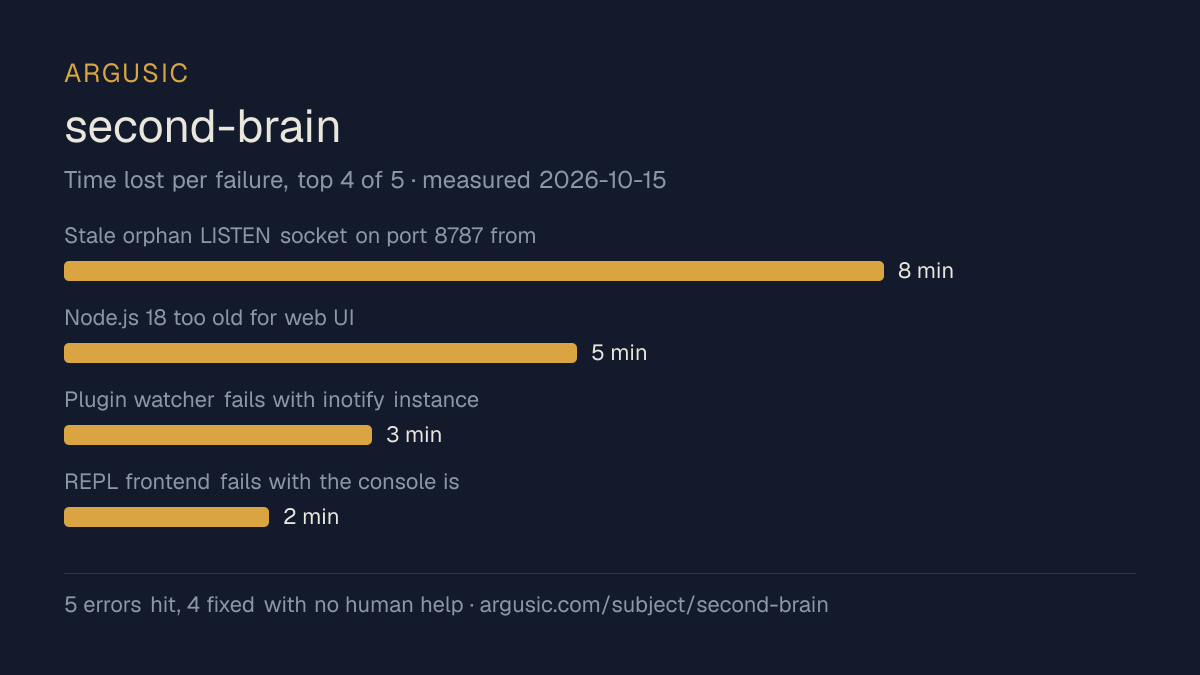
What went wrong, in the agent's own words
The agent's own words, worst first, never rewritten into advice.
- Stale orphan LISTEN socket on port 8787 from prior test processes blocks HTTP frontend. No process holds the socket but it persists in LISTEN state.8 minutes
- Node.js 18 too old for web UI (requires ^20.19.0 or >=22.12.0). Vite fails with SyntaxError on node:util.styleText.5 minutes
- Plugin watcher fails with inotify instance limit reached (EMFILE, errno 24) when orphaned guest.child subprocesses accumulate from test runs.3 minutes
- REPL frontend fails with the console is closed in non-interactive environment (no TTY available).2 minutes
- 2 pre-existing test failures in test_sandbox_processes.py: test_starting_a_process_asks_unless_something_vouches_for_it[ls-proc.run] and [ls-proc.start] - sandbox now classifies ls as safe but tests expect it to be unsafe.
- Install time
- 51 minutes
- Cold machine to finish
- 51 minutes
- Errors hit and fixed
- 5 hit, 4 fixed with no human help
- How the result was proved
- pytest: 2819 passed, 2 failed, 5 skipped across 129 test files. SDK POST /sdk/config.read?thread=t1 returned HTTP 200 with {data: 8789}. GET /health returned HTTP 401 (expected, requires Bearer token). Web UI builds: npx vite build produced dist/ in 1.14s. App launches and logs frontend http is serving on 127.0.0.1:8789.
- Model tokens used
- 1,869,807
- Exact commit tested
- d79ca2e1859a
- Container image
- sha256:cdd920bce783
What was not measured
The other half, so you can see exactly how far this evidence goes. A gap is printed as a gap and never filled in.
- Peak GPU memory
- this ran on a CPU machine, so there was no GPU to sample
- Behaviour over a long run
- each attempt uses the smallest documented settings and a fixed time budget, so this measures whether it runs, not how it holds up under load
The end of the recording
The last lines of the terminal session that decided this verdict, exactly as they were recorded.
**Tests**: 2819 passed, 2 failed (pre-existing regression in sandbox process safety classification)…
tokens used
1,869,807
The report is complete and verified. Here's a summary of what was done:
**Installation**: Python `pip install -r requirements.txt` and `npm install` in `frame_ui/` both su…
**Two environment issues found and worked around**:
1. **Node.js 18** on the system is too old for the web UI. Downloaded Node v22.12.0 binary and used…
2. An **orphan TCP socket** on port 8787 (left by prior test processes) blocks the HTTP frontend on…
**Launch**: The app starts and serves the HTTP frontend on port 8789. SDK requests respond:
- `POST /sdk/config.read?thread=t1` → HTTP 200 with config data
- `GET /health` → HTTP 401 (expected, requires auth token)
**Tests**: 2819 passed, 2 failed (pre-existing regression in sandbox process safety classification)…
Replay the whole session, every command from a clean machine to this point.
How it was tested
One agent, one container, no human help. It installs the project the way its own documentation says to, runs it, and fixes what breaks. Everything below is recorded as it happened: the terminal session, the log and the exact commit. The full method.
Strengths and limits
Measured facts, not opinions. How this is written.
What went well
- Reached a running state on a clean machine, with the session recorded.
- Ran without a GPU, so it does not need one to start.
- Licensed MIT, as reported by its host.
What did not, or is not known
- Took 51 minutes to install, slower than the median of the 38 comparable projects Argusic has measured.
- Hit 5 errors during setup, 1 of which were not solved.
- Measured once so far. A single attempt shows it can run, not that it runs reliably.
Of the 39 agentic-ai projects Argusic has installed and timed, second-brain was the 39th fastest to reach a running state, and 31 of 39 reached one at all.
What it is a reasonable choice for
- Trying it on a laptop or a small server: it reached a running state without a GPU.
Also tested, in the same area
Every one of these was installed and run by Argusic on a clean machine. Nothing appears here that was not tested.
Run history
Topics (from GitHub)
agentic-aiagentic-workflowaiai-agent-toolsai-agentscronjob-schedulerdata-sciencedatabasellmsmultimodalopen-sourceorchestratorpythonpython3ragtool-useworkflow-automation
Embed the badge
Markdown for the project README. It links back here; terms on the terms page.
[](https://argusic.com/subject/second-brain)Questions
- Does second-brain run?
- Yes. second-brain runs. Argusic installed and launched it on a clean machine in 51 minutes, hitting 5 errors on the way, and recorded the session.
- How did Argusic test second-brain?
- On a fresh, disposable machine, with every command recorded and the repository pinned at commit d79ca2e1859a. One attempt is recorded, and the full method is on the methodology page.
- What did it cost to test second-brain?
- The run that produced this verdict cost $0.10: real compute and model cost, not a list price per million tokens. It is recorded on that run's page.
- How long does second-brain take to install?
- 51 minutes in the run that decided this verdict, from a clean machine to a running state. That is one measured attempt, not an average.
- Does second-brain need a GPU?
- Not to start. Argusic reached a running state on a machine with no GPU.
- What goes wrong when installing second-brain?
- 5 things broke in the recorded run, and 4 were fixed without human help. Each one, and the time it cost, is listed on this page.
- How does second-brain compare with the alternatives?
- Of the 39 agentic-ai projects Argusic has installed and timed, second-brain was the 39th fastest to reach a running state, and 31 of 39 reached one at all.
- Where is the evidence for second-brain?
- The recorded run is on this page, each linking to its full log and terminal recording, stored with a sha256 fingerprint so it cannot be quietly altered.