rustwright
Playwright's API on a Rust CDP engine, Chromium browser automation for Python & Node, no driver subprocess. (Alpha)
Runssource: GitHubPythonMITcommit fca14389e997
Python, MIT licensed. The project labels itself: browser automation, cdp, chrome devtools protocol, chromium, napi rs, nodejs, playwright and pyo3.
rustwright runs. An Argusic agent installed it in 20 minutes and hit 6 errors and fixed every one without help on a clean machine with no GPU, and the whole session was recorded.
Built from source with Rust 1.99 and Python 3.12; Chromium 155 installed and launchable; Python quickstart prints 'Rustwright works', 18-test CI subset passes, Node smoke and 19 Node tests pass, rustwright CLI (0.3.0) and native rustwright-cli (0.1.0) open/snapshot/close real browser sessions, MCP server answers initialize; 30 sync_api tests fail against real Chromium and the full-file suite has flaky hangs.
What the agent ended up with on a clean machine, in its own words. How this is measured
Measured by Argusic on a fresh machine every time. Every number links to its evidence. Argusic Score 95 of 100 (the mean of this project's run scores).
At a glance
Subject data from GitHub, linked at the top of this page, refreshed . Test data by Argusic (CC BY 4.0); every number links to a run page with the full log, the recording, and their sha256 hashes.
What was measured
From the run that decided this verdict. Every line is a recorded value, not an estimate.
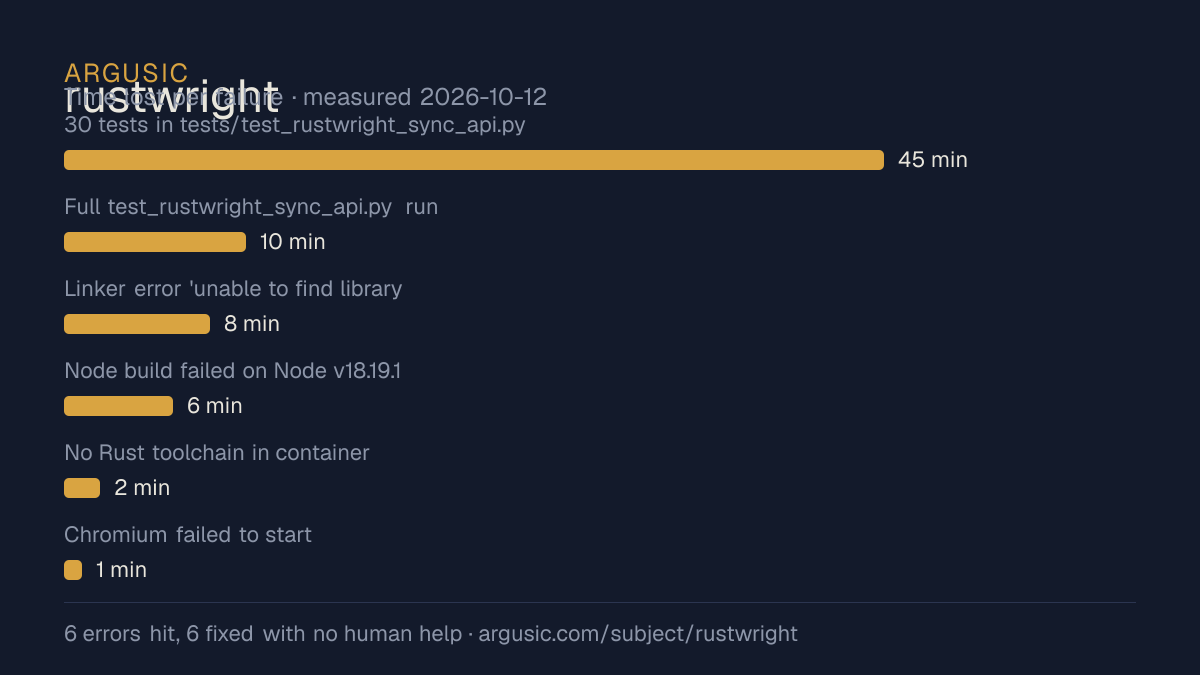
What went wrong, in the agent's own words
The agent's own words, worst first, never rewritten into advice.
- 30 tests in tests/test_rustwright_sync_api.py fail against real Chromium: connect_over_cdp remote-cookie sync (empty cookie set), page.requests() window (20 kept, expected 100), HAR route_fulfill FileNotFoundError leak, navigation-mid-wait 'Execution context was destroyed' races, sandbox=true launch (no usable sandbox in this container), internal __rustwright_dispatch__ shim visibility; CI fast subset stays green45 minutes
- Full test_rustwright_sync_api.py run (1639 tests) hangs ~45% in batch mode (flaky Chromium race tests)10 minutes
- Linker error 'unable to find library -lpython3.12' (libpython3.12.so absent; no root/apt)8 minutes
- Node build failed on Node v18.19.1: '@inquirer/core' requires node:util.styleText (Node >=20.13)6 minutes
- No Rust toolchain in container (cargo/rustc missing)2 minutes
- Chromium failed to start: posix_spawn chrome_crashpad_handler: Permission denied (13); installer delivered browser helpers without exec bits1 minute
- Install time
- 20 minutes
- Cold machine to finish
- 68 minutes
- Errors hit and fixed
- 6 hit, 6 fixed with no human help
- How the result was proved
- cargo check --locked exit 0; cargo test --locked 399 passed 0 failed; maturin develop --release installed rustwright 0.3.0; examples/quickstart.py printed 'Rustwright works'; pytest fast CI subset 18 passed; npm run smoke OK and npm test 19/19 passed; rustwright --version = 0.3.0; rustwright open/snapshot --json/--allow-eval eval/close all returned real results over live Chromium; native rustwright-cli 0.1.0 open/snapshot/close OK; rustwright-mcp answered JSON-RPC initialize with serverInfo rustwright-mcp 0.1.0; mcp crate cargo test 34 passed
- Model tokens used
- 1,055,766
- Exact commit tested
- fca14389e997
- Container image
- sha256:cdd920bce783
What was not measured
The other half, so you can see exactly how far this evidence goes. A gap is printed as a gap and never filled in.
- Peak GPU memory
- this ran on a CPU machine, so there was no GPU to sample
- Behaviour over a long run
- each attempt uses the smallest documented settings and a fixed time budget, so this measures whether it runs, not how it holds up under load
The end of the recording
The last lines of the terminal session that decided this verdict, exactly as they were recorded.
- MCP: `cargo test mcp` 34 passed; MCP `initialize` JSON-RPC response OK
**Errors fixed:**
1. No Rust toolchain → installed rustup stable 1.99 (2 min)
2. `libpython3.12.so` missing → extracted from Ubuntu `.deb` locally, `LIBRARY_PATH`/`LD_LIBRARY_PA…
3. Chromium `chrome_crashpad_handler` not executable (installer dropped exec bits) → `chmod +x` (1 …
4. Node build failed on Node 18 (`node:util.styleText` unsupported) → installed Node 20.20.2 locall…
**Unfixed failures (30 tests in `test_rustwright_sync_api.py`):** connect-over-CDP remote-cookie sy…
FINISH
All tasks complete. Final report:
tokens used
1,055,766
All tasks complete. Final report:
Replay the whole session, every command from a clean machine to this point.
How it was tested
One agent, one container, no human help. It installs the project the way its own documentation says to, runs it, and fixes what breaks. Everything below is recorded as it happened: the terminal session, the log and the exact commit. The full method.
Strengths and limits
Measured facts, not opinions. How this is written.
What went well
- Reached a running state on a clean machine, with the session recorded.
- Recovered from all 6 errors without a human stepping in, which says the failures are documented well enough to solve.
- Ran without a GPU, so it does not need one to start.
- Licensed MIT, as reported by its host.
- Measured 2 times, so the result is not a one-off.
What did not, or is not known
- Took 20 minutes to install, slower than the median of the 14 comparable projects Argusic has measured.
Of the 15 browser-automation projects Argusic has installed and timed, rustwright was the 15th fastest to reach a running state, and 13 of 15 reached one at all.
What it is a reasonable choice for
- Trying it on a laptop or a small server: it reached a running state without a GPU.
Also tested, in the same area
Every one of these was installed and run by Argusic on a clean machine. Nothing appears here that was not tested.
Run history
Topics (from GitHub)
browser-automationcdpchrome-devtools-protocolchromiumnapi-rsnodejsplaywrightpyo3pythonrust
Embed the badge
Markdown for the project README. It links back here; terms on the terms page.
[](https://argusic.com/subject/rustwright)Questions
- Does rustwright run?
- Yes. rustwright runs. Argusic installed and launched it on a clean machine in 20 minutes, hitting 6 errors on the way, and recorded the session.
- How did Argusic test rustwright?
- On a fresh, disposable machine, with every command recorded and the repository pinned at commit fca14389e997. 2 attempts are recorded, and the full method is on the methodology page.
- What did it cost to test rustwright?
- The run that produced this verdict cost $0.34: real compute and model cost, not a list price per million tokens. It is recorded on that run's page.
- How long does rustwright take to install?
- 20 minutes in the run that decided this verdict, from a clean machine to a running state. That is one measured attempt, not an average.
- Does rustwright need a GPU?
- Not to start. Argusic reached a running state on a machine with no GPU.
- What goes wrong when installing rustwright?
- 6 things broke in the recorded run, and 6 were fixed without human help. Each one, and the time it cost, is listed on this page.
- How does rustwright compare with the alternatives?
- Of the 15 browser-automation projects Argusic has installed and timed, rustwright was the 15th fastest to reach a running state, and 13 of 15 reached one at all.
- Where is the evidence for rustwright?
- All 2 recorded runs are on this page, each linking to its full log and terminal recording, stored with a sha256 fingerprint so it cannot be quietly altered.