Dive
Dive is an open-source MCP Host Desktop Application that seamlessly integrates with any LLMs supporting function calling capabilities. ✨
Runs with mockssource: GitHubTypeScriptMITcommit 5fb62b91b55c
TypeScript, MIT licensed. The project labels itself: ai, ai agents, llm interface, llm ui, mcp client, mcp host, mcp server and ollama.
Dive runs, with stand-ins for the services it depends on. An Argusic agent installed it in 31 minutes and hit 6 errors and fixed every one without help on a clean machine with no GPU, and the whole session was recorded.
Installed with Node v22.14.0 and uv 0.12.23; `npm run build:electron` and `npm run check` exit 0; 287 mcp-host pytest pass; Electron app launches on Xvfb display with host reporting state UP and its HTTP API answering 200 on three endpoints.
What the agent ended up with on a clean machine, in its own words. How this is measured
Measured by Argusic on a fresh machine every time. Every number links to its evidence. Argusic Score 92 of 100 (the mean of this project's run scores).
At a glance
Subject data from GitHub, linked at the top of this page, refreshed . Test data by Argusic (CC BY 4.0); every number links to a run page with the full log, the recording, and their sha256 hashes.
What was measured
From the run that decided this verdict. Every line is a recorded value, not an estimate.
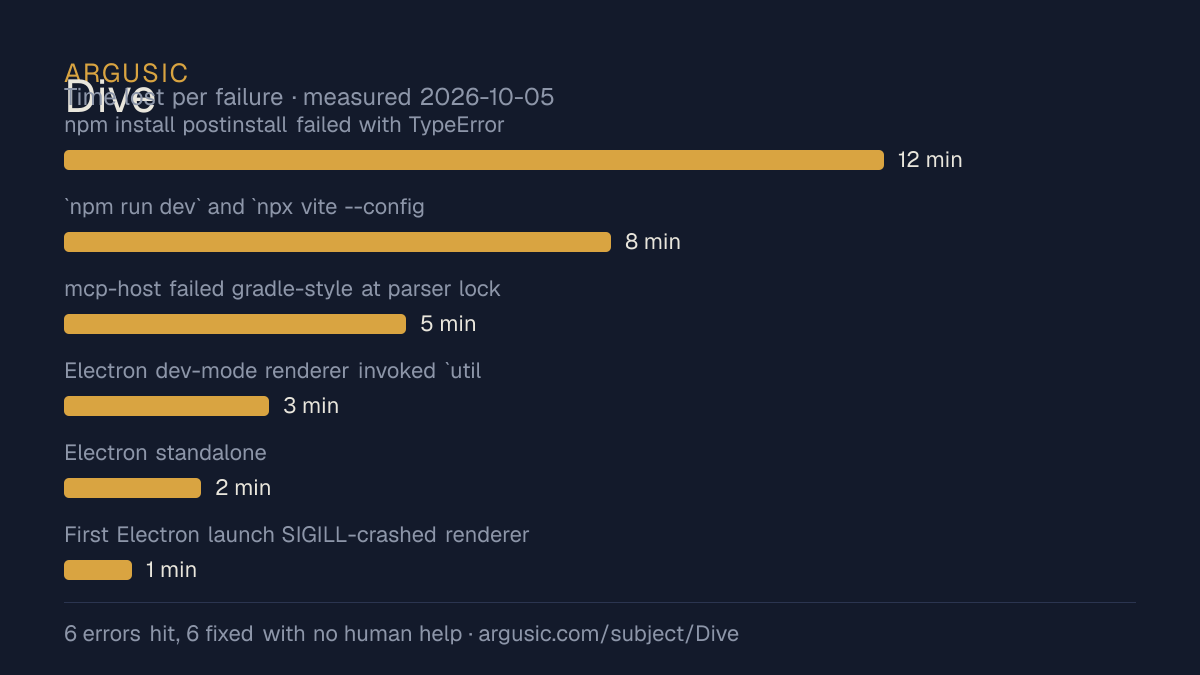
What went wrong, in the agent's own words
The agent's own words, worst first, never rewritten into advice.
- npm install postinstall failed with TypeError on @electron/rebuild (node-gyp 'paths[0]' undefined) under system Node v18.19.1 (project's vite/vitest require ^20.19/22.x)12 minutes
- `npm run dev` and `npx vite --config vite.config.electron.ts` in dev mode fataled on 'SUID sandbox helper ... not configured correctly' (container chrome-sandbox lacks root:root 4755)8 minutes
- mcp-host failed gradle-style at parser lock due to sandbox: `uv` binary not in container; `pip3 install uv` blocked by PEP 668 externally-managed environment, and README's `uv sync` (mcp-host) is a required step5 minutes
- Electron dev-mode renderer invoked `util:setModelSettings` but config dir did not exist, causing repeated Unhandled Rejection ENOENT .config/model_settings.json3 minutes
- Electron standalone (without VITE_DEV_SERVER_URL) spawns `uv run dive_httpd` from repo root where there is no pyproject.toml, so the host exited code 2 and the app reported no server2 minutes
- First Electron launch SIGILL-crashed renderer after the OAP plugin reached the real proxy.oaphub.ai (remote OAuth loop; CPU+crash); transient and occurred once, not reproducible1 minute
- Install time
- 31 minutes
- Cold machine to finish
- 27 minutes
- Errors hit and fixed
- 6 hit, 6 fixed with no human help
- How the result was proved
- uv run pytest -q in mcp-host: 287 passed, 52 skipped, 5 subtests passed; npm run build:electron: exit 0 ('built in 21s / dist-electron/main/index.js'); tsc -b exit 0; launched Electron main twice (used and dev modes): main stayed up full timeout, bus reported state UP, exit 124 (SIGTERM timeout), no unhandled rejections; standalone host curl: GET /api/config/mcpserver, /api/tools/initialized, /api/skills/ all HTTP 200 JSON
- Model tokens used
- 1,270,556
- Exact commit tested
- 5fb62b91b55c
- Container image
- sha256:cdd920bce783
What was not measured
The other half, so you can see exactly how far this evidence goes. A gap is printed as a gap and never filled in.
- Peak GPU memory
- this ran on a CPU machine, so there was no GPU to sample
- Behaviour over a long run
- each attempt uses the smallest documented settings and a fixed time budget, so this measures whether it runs, not how it holds up under load
- Behaviour against real services
- this run was verified against stand-in services only
The end of the recording
The last lines of the terminal session that decided this verdict, exactly as they were recorded.
model_settings errors: 0
SIGILL: 0
exec
/bin/sh -lc "grep -c \"state: 'UP'\" /tmp/electron-final2.log /tmp/dev-live.log; grep -o \"state: '…
 succeeded in 0ms:
/tmp/electron-final2.log:2
/tmp/dev-live.log:2
2
The final as-launched runs reported `state: 'UP'` twice each (bus file written twice on startup) wi…
tokens used
1,270,556
The final as-launched runs reported `state: 'UP'` twice each (bus file written twice on startup) wi…
Replay the whole session, every command from a clean machine to this point.
How it was tested
One agent, one container, no human help. It installs the project the way its own documentation says to, runs it, and fixes what breaks. Everything below is recorded as it happened: the terminal session, the log and the exact commit. The full method.
Strengths and limits
Measured facts, not opinions. How this is written.
What went well
- Recovered from all 6 errors without a human stepping in, which says the failures are documented well enough to solve.
- Licensed MIT, as reported by its host.
What did not, or is not known
- Only reached a running state against stand-in services, so nothing here proves it works against the real ones.
- Took 31 minutes to install, slower than the median of the 91 comparable projects Argusic has measured.
- Measured once so far. A single attempt shows it can run, not that it runs reliably.
Of the 92 ai projects Argusic has installed and timed, Dive was the 87th fastest to reach a running state, and 64 of 92 reached one at all.
Also tested, in the same area
Every one of these was installed and run by Argusic on a clean machine. Nothing appears here that was not tested.
Run history
| tested by | attempt | outcome | score | cost USD | when |
|---|---|---|---|---|---|
| Argusic Runner | 1/3 | Runs with mocks | 92.00 | 0.30 |
Topics (from GitHub)
aiai-agentsllm-interfacellm-uimcp-clientmcp-hostmcp-serverollamaollama-clientollama-ui
Embed the badge
Markdown for the project README. It links back here; terms on the terms page.
[](https://argusic.com/subject/dive)Questions
- Does Dive run?
- Dive runs, with mocks standing in for external services. Argusic installed and launched it on a clean machine in 31 minutes, hitting 6 errors on the way, and recorded the session.
- How did Argusic test Dive?
- On a fresh, disposable machine, with every command recorded and the repository pinned at commit 5fb62b91b55c. One attempt is recorded, and the full method is on the methodology page.
- What did it cost to test Dive?
- The run that produced this verdict cost $0.30: real compute and model cost, not a list price per million tokens. It is recorded on that run's page.
- How long does Dive take to install?
- 31 minutes in the run that decided this verdict, from a clean machine to a running state. That is one measured attempt, not an average.
- Does Dive need a GPU?
- Not to start. Argusic reached a running state on a machine with no GPU.
- What goes wrong when installing Dive?
- 6 things broke in the recorded run, and 6 were fixed without human help. Each one, and the time it cost, is listed on this page.
- How does Dive compare with the alternatives?
- Of the 92 ai projects Argusic has installed and timed, Dive was the 87th fastest to reach a running state, and 64 of 92 reached one at all.
- Where is the evidence for Dive?
- The recorded run is on this page, each linking to its full log and terminal recording, stored with a sha256 fingerprint so it cannot be quietly altered.