stackql
Query, provision and operate Cloud, SaaS, API and Model Context Protocol (MCP) resources through a unified SQL-based framework for humans and AI agents.
Runs with mockssource: GitHubhomepageGoMITcommit adc09567d4ba
Go, MIT licensed. The project labels itself: ai agents, asset management, cloud, cloud automation, cloud config, cloud operations, cloud security and cspm.
stackql runs, with stand-ins for the services it depends on. An Argusic agent installed it in 60 minutes and hit 5 errors and fixed every one without help on a clean machine with no GPU, and the whole session was recorded.
Both stackql and stackql_mcp_client binaries build from source on Ubuntu 24.04 with Go 1.25.14; all 53 Go unit test packages pass; 603 of 668 robot functional tests pass covering SQL queries, provider discovery, MCP server, REST/GraphQL/keyset pagination, body coercion, and XML walking against mocked backends;
What the agent ended up with on a clean machine, in its own words. How this is measured
Measured by Argusic on a fresh machine every time. Every number links to its evidence. Argusic Score 92 of 100 (the mean of this project's run scores).
At a glance
Subject data from GitHub, linked at the top of this page, refreshed . Test data by Argusic (CC BY 4.0); every number links to a run page with the full log, the recording, and their sha256 hashes.
What was measured
From the run that decided this verdict. Every line is a recorded value, not an estimate.
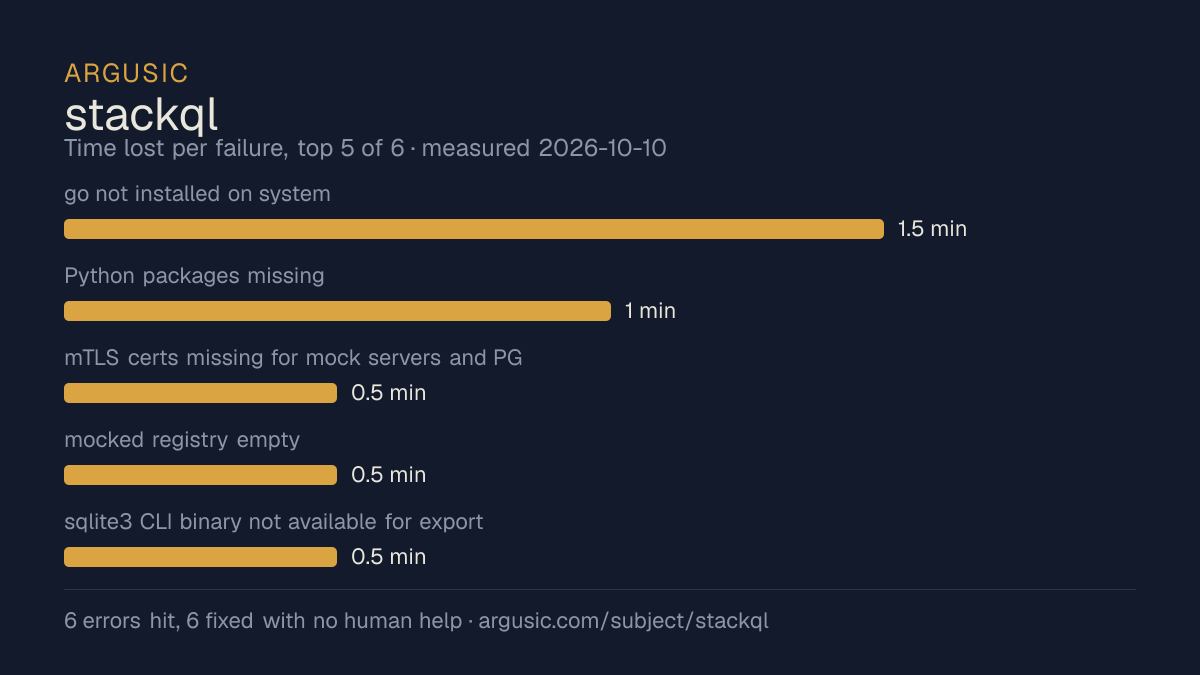
What went wrong, in the agent's own words
The agent's own words, worst first, never rewritten into advice.
- Go 1.25.x not found in container3 minutes
- pip install failed: externally-managed-environment error2 minutes
- TLS certificates missing at test/server/mtls/credentials/2 minutes
- stackql_mcp_client binary not built by default build script1 minute
- Registry mock Flask app hardcodes port 5000 in __main__1 minute
- Install time
- 60 minutes
- Cold machine to finish
- 61 minutes
- Errors hit and fixed
- 5 hit, 5 fixed with no human help
- How the result was proved
- go test -count=1 -timeout 1200s ./... -> 53 packages, 0 failures; robot --variable EXECUTION_PLATFORM:native --variable SQL_BACKEND:sqlite_embedded test/robot/functional/ -> 603/668 passed; ./build/stackql exec 'SELECT verified as status' -> returns |verified| row; ./build/stackql exec 'SHOW VERSION' -> 1.1.1
- Model tokens used
- 500,633
- Exact commit tested
- adc09567d4ba
- Container image
- sha256:cdd920bce783
What was not measured
The other half, so you can see exactly how far this evidence goes. A gap is printed as a gap and never filled in.
- Peak GPU memory
- this ran on a CPU machine, so there was no GPU to sample
- Behaviour over a long run
- each attempt uses the smallest documented settings and a fixed time budget, so this measures whether it runs, not how it holds up under load
- Behaviour against real services
- this run was verified against stand-in services only
The end of the recording
The last lines of the terminal session that decided this verdict, exactly as they were recorded.
**MCP tests after building client:** 44/75 passed (31 failures: remaining mock-server infra gaps).
**Manual binary verification:** `exec "SELECT 'verified' as status"` → returns expected row. `SHOW …
**Errors encountered and fixed:** Go not installed (installed tarball), pip externally-managed (cre…
tokens used
500,633
All evidence collected. Here is the final report:
**Install:** Built `stackql` (104 MB) and `stackql_mcp_client` (16 MB) from source. Required instal…
**Go unit tests:** All 53 packages pass (`go test -count=1 -timeout 1200s ./...`).
**Robot functional tests (full-suite with mocks via `__init__.robot`):** 603/668 passed (90%). The …
**MCP tests after building client:** 44/75 passed (31 failures: remaining mock-server infra gaps).
**Manual binary verification:** `exec "SELECT 'verified' as status"` → returns expected row. `SHOW …
**Errors encountered and fixed:** Go not installed (installed tarball), pip externally-managed (cre…
Replay the whole session, every command from a clean machine to this point.
How it was tested
One agent, one container, no human help. It installs the project the way its own documentation says to, runs it, and fixes what breaks. Everything below is recorded as it happened: the terminal session, the log and the exact commit. The full method.
Strengths and limits
Measured facts, not opinions. How this is written.
What went well
- Recovered from all 5 errors without a human stepping in, which says the failures are documented well enough to solve.
- Licensed MIT, as reported by its host.
- Measured 2 times, so the result is not a one-off.
What did not, or is not known
- Only reached a running state against stand-in services, so nothing here proves it works against the real ones.
- Took 60 minutes to install, slower than the median of the 123 comparable projects Argusic has measured.
Of the 124 ai-agents projects Argusic has installed and timed, stackql was the 120th fastest to reach a running state, and 96 of 124 reached one at all.
Also tested, in the same area
Every one of these was installed and run by Argusic on a clean machine. Nothing appears here that was not tested.
Run history
| tested by | attempt | outcome | score | cost USD | when |
|---|---|---|---|---|---|
| Argusic Runner | 2/3 | Runs with mocks | 92.00 | 0.35 | |
| Argusic Runner | 1/3 | Runs with mocks | 92.00 | 0.46 |
Topics (from GitHub)
ai-agentsasset-managementcloudcloud-automationcloud-configcloud-operationscloud-securitycspmidentity-governanceinfrastructure-as-codellm-toolsmcpmodel-context-protocolsqlstackqlxops
Embed the badge
Markdown for the project README. It links back here; terms on the terms page.
[](https://argusic.com/subject/stackql)Questions
- Does stackql run?
- stackql runs, with mocks standing in for external services. Argusic installed and launched it on a clean machine in 60 minutes, hitting 5 errors on the way, and recorded the session.
- How did Argusic test stackql?
- On a fresh, disposable machine, with every command recorded and the repository pinned at commit adc09567d4ba. 2 attempts are recorded, and the full method is on the methodology page.
- What did it cost to test stackql?
- The run that produced this verdict cost $0.35: real compute and model cost, not a list price per million tokens. It is recorded on that run's page.
- How long does stackql take to install?
- 60 minutes in the run that decided this verdict, from a clean machine to a running state. That is one measured attempt, not an average.
- Does stackql need a GPU?
- Not to start. Argusic reached a running state on a machine with no GPU.
- What goes wrong when installing stackql?
- 5 things broke in the recorded run, and 5 were fixed without human help. Each one, and the time it cost, is listed on this page.
- How does stackql compare with the alternatives?
- Of the 124 ai-agents projects Argusic has installed and timed, stackql was the 120th fastest to reach a running state, and 96 of 124 reached one at all.
- Where is the evidence for stackql?
- All 2 recorded runs are on this page, each linking to its full log and terminal recording, stored with a sha256 fingerprint so it cannot be quietly altered.