mianshiya
持续维护的企业面试题库网站,帮你拿到满意 offer!⭐️ 2026年最新Java面试题、前端面试题、AI大模型面试题、AI Agent面试题、RAG面试题、C++面试题、Go面试题、Python面试题、测试面试题、运维面试题、后端面试题、操作系统面试题、计算机网络面试题、Redis面试题、MySQL数据库面试题、算法面试题、Spring面试题、JVM面试题、Java并发面试题、Linux面试题、LLM面试题、Prompt工程面试题、系统设计面试题等1万多道高频程序员求职必备八股文。面试刷题就选面试鸭 💎 React 前端 + Node 后端 + 云开发全栈项目 by 程序员鱼皮
Runssource: GitHubTypeScriptMITcommit 7354f4859b74
TypeScript, MIT licensed. The project labels itself: ai, ai agents, algorithm, ant design, backend, cpp, css and database.
mianshiya runs. An Argusic agent installed it in 15 minutes and hit 5 errors and fixed every one without help on a clean machine with no GPU, and the whole session was recorded.
The React frontend builds and its dev server serves the 面试鸭 homepage with HTTP 200 on port 8000, and the Node backend starts and serves its static-data API (POST /api/tag/get/map returning HTTP 200 with JSON) on port 7592; data/auth endpoints still require real Tencent CloudBase, MongoDB and Redis credentials.
What the agent ended up with on a clean machine, in its own words. How this is measured
Measured by Argusic on a fresh machine every time. Every number links to its evidence. Argusic Score 100 of 100 (the mean of this project's run scores).
At a glance
Subject data from GitHub, linked at the top of this page. Test data by Argusic (CC BY 4.0); every number links to a run page with the full log, the recording, and their sha256 hashes.
What was measured
From the run that decided this verdict. Every line is a recorded value, not an estimate.
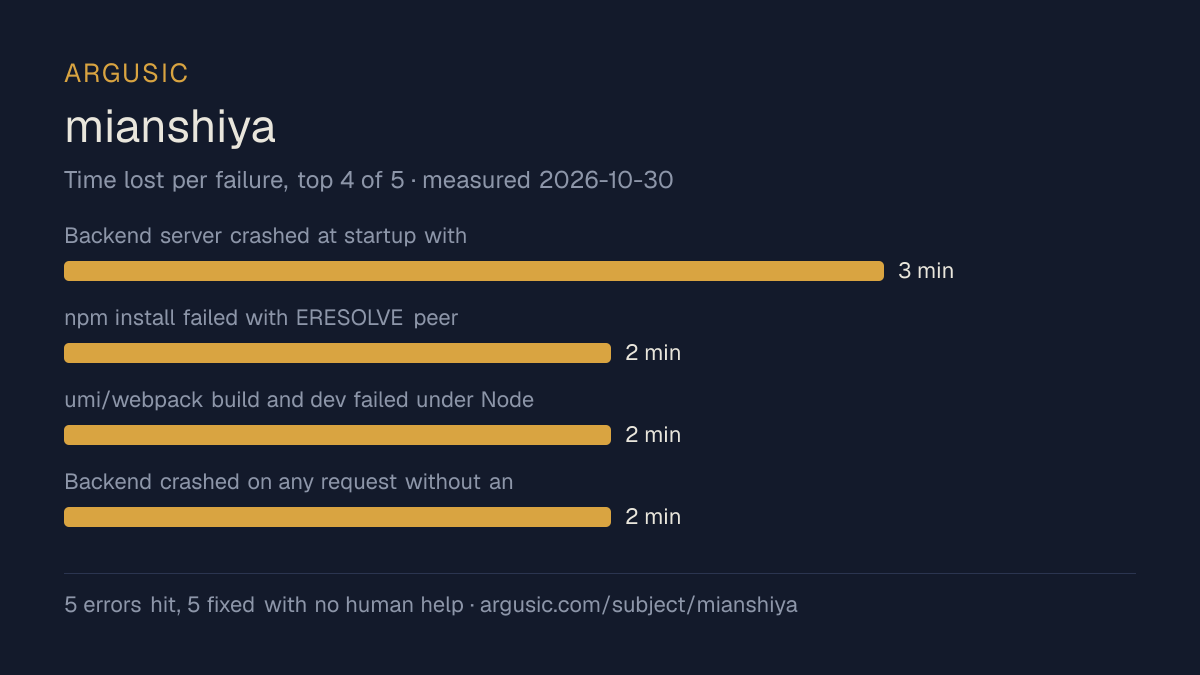
What went wrong, in the agent's own words
The agent's own words, worst first, never rewritten into advice.
- Backend server crashed at startup with 'ReferenceError: File is not defined' from undici 7.30.1 (pulled transitively by cheerio 1.2.0, which requires Node 20 globals that Node 18.19 lacks)3 minutes
- npm install failed with ERESOLVE peer dependency conflict (braft-editor requires react ^16 while project uses react ^17); yarn is not installed2 minutes
- umi/webpack build and dev failed under Node 18 with ERR_OSSL_EVP_UNSUPPORTED (webpack 5 MD4 hash rejected by OpenSSL 3)2 minutes
- Backend crashed on any request without an Origin header: ERR_HTTP_INVALID_HEADER_VALUE 'undefined' for Access-Control-Allow-Origin in server/src/server.js CORS middleware2 minutes
- Database/auth-backed endpoints (question search, login, etc.) need real Tencent CloudBase env/secretId/secretKey plus Redis/MongoDB; the shipped config uses placeholder values (env 'mianshiya-xxx', secretId/secretKey 'xxx')
- Install time
- 15 minutes
- Cold machine to finish
- 13 minutes
- Errors hit and fixed
- 5 hit, 5 fixed with no human help
- How the result was proved
- curl -s -o /dev/null -w %{http_code} http://localhost:8000/ returned 200; curl -s -X POST http://localhost:7592/api/tag/get/map -H 'Content-Type: application/json' -d '{}' returned HTTP 200 with JSON body; npm run build exited 0 with 'Webpack: Compiled successfully'; backend log showed 'server start at 7592, env = local'
- Model tokens used
- 313,244
- Exact commit tested
- 7354f4859b74
- Container image
- sha256:cdd920bce783
What was not measured
The other half, so you can see exactly how far this evidence goes. A gap is printed as a gap and never filled in.
- Peak GPU memory
- this ran on a CPU machine, so there was no GPU to sample
- Behaviour over a long run
- each attempt uses the smallest documented settings and a fixed time budget, so this measures whether it runs, not how it holds up under load
The end of the recording
The last lines of the terminal session that decided this verdict, exactly as they were recorded.
      res.setHeader('Access-Control-Allow-Credentials', 'true');
      // 允许的地址 http://127.0.0.1:9000 这样的格式
      const origin = req.get('Origin');
      if (origin) {
        res.setHeader('Access-Control-Allow-Origin', origin);
      }
      // 允许跨域请求的方法
      res.setHeader('Access-Control-Allow-Methods', 'POST, GET, OPTIONS, DELETE, PUT');
Now I'll produce the final report.
tokens used
313,244
Now I'll produce the final report.
Replay the whole session, every command from a clean machine to this point.
How it was tested
One agent, one container, no human help. It installs the project the way its own documentation says to, runs it, and fixes what breaks. Everything below is recorded as it happened: the terminal session, the log and the exact commit. The full method.
Strengths and limits
Measured facts, not opinions. How this is written.
What went well
- Reached a running state on a clean machine, with the session recorded.
- Recovered from all 5 errors without a human stepping in, which says the failures are documented well enough to solve.
- Ran without a GPU, so it does not need one to start.
- Licensed MIT, as reported by its host.
What did not, or is not known
- Took 15 minutes to install, slower than the median of the 225 comparable projects Argusic has measured.
- Measured once so far. A single attempt shows it can run, not that it runs reliably.
Of the 226 ai projects Argusic has installed and timed, mianshiya was the 170th fastest to reach a running state, and 148 of 226 reached one at all.
What it is a reasonable choice for
- Trying it on a laptop or a small server: it reached a running state without a GPU.
Also tested, in the same area
Every one of these was installed and run by Argusic on a clean machine. Nothing appears here that was not tested.
Run history
Topics (from GitHub)
aiai-agentsalgorithmant-designbackendcppcssdatabasefrontendgolanginterviewjavajavascriptnodejsprogrammerpythonreactredistypescript
Embed the badge
Markdown for the project README. It links back here; terms on the terms page.
[](https://argusic.com/subject/mianshiya)Questions
- Does mianshiya run?
- Yes. mianshiya runs. Argusic installed and launched it on a clean machine in 15 minutes, hitting 5 errors on the way, and recorded the session.
- How did Argusic test mianshiya?
- On a fresh, disposable machine, with every command recorded and the repository pinned at commit 7354f4859b74. One attempt is recorded, and the full method is on the methodology page.
- What did it cost to test mianshiya?
- The run that produced this verdict cost $0.12: real compute and model cost, not a list price per million tokens. It is recorded on that run's page.
- How long does mianshiya take to install?
- 15 minutes in the run that decided this verdict, from a clean machine to a running state. That is one measured attempt, not an average.
- Does mianshiya need a GPU?
- Not to start. Argusic reached a running state on a machine with no GPU.
- What goes wrong when installing mianshiya?
- 5 things broke in the recorded run, and 5 were fixed without human help. Each one, and the time it cost, is listed on this page.
- How does mianshiya compare with the alternatives?
- Of the 226 ai projects Argusic has installed and timed, mianshiya was the 170th fastest to reach a running state, and 148 of 226 reached one at all.
- Where is the evidence for mianshiya?
- The recorded run is on this page, each linking to its full log and terminal recording, stored with a sha256 fingerprint so it cannot be quietly altered.