compound-memory
Long-term memory for Claude Code and Codex: turns your daily AI sessions into a persistent memory of your preferences, decisions and open threads, injected at the start of every new session, on any machine. Local-first, zero dependencies. 让 AI 跨会话、跨机器、跨工具记住你。
Runs with mockssource: GitHubPythonMITcommit 937080747f60
Python, MIT licensed. The project labels itself: agent memory, ai agents, ai memory, claude code, claude code hooks, codex, coding agent and context engineering.
compound-memory runs, with stand-ins for the services it depends on. An Argusic agent installed it in 7 minutes and hit 3 errors and fixed every one without help on a clean machine with no GPU, and the whole session was recorded.
cm doctor, cm snapshot, cm recall, cm distill, cm sessions, and cm --version all return correct output after patching 3 Python bugs and configuring a local mock LLM backend.
What the agent ended up with on a clean machine, in its own words. How this is measured
Measured by Argusic on a fresh machine every time. Every number links to its evidence. Argusic Score 92 of 100 (the mean of this project's run scores).
At a glance
Subject data from GitHub, linked at the top of this page, refreshed . Test data by Argusic (CC BY 4.0); every number links to a run page with the full log, the recording, and their sha256 hashes.
What was measured
From the run that decided this verdict. Every line is a recorded value, not an estimate.
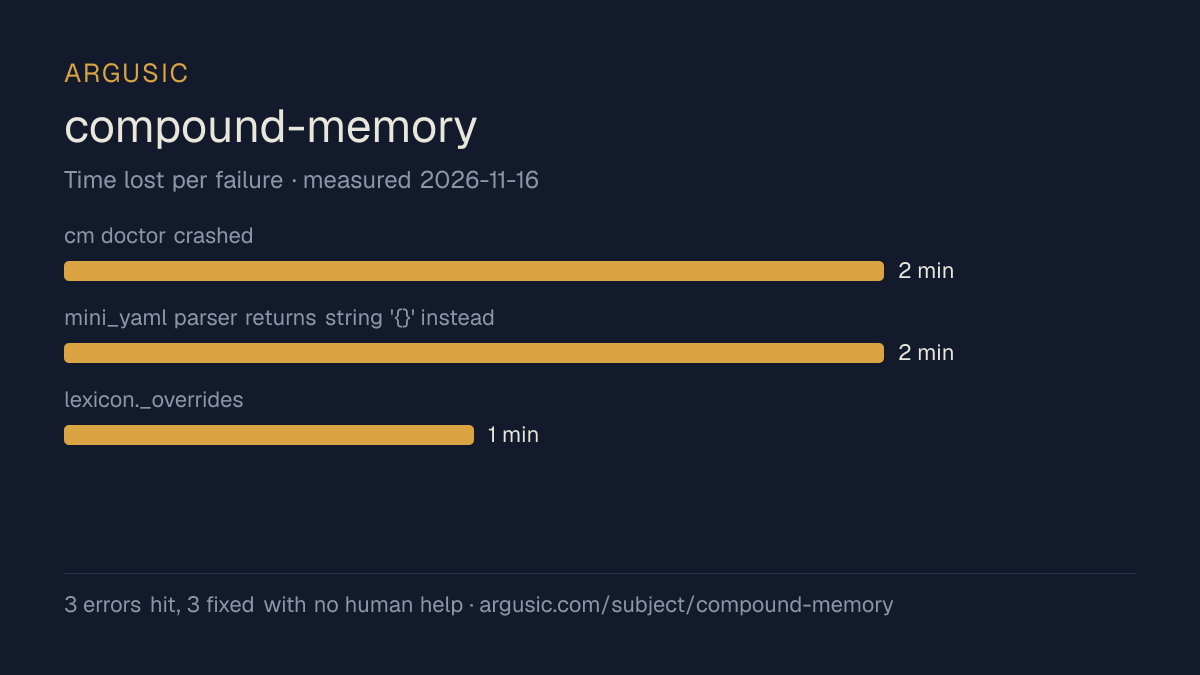
What went wrong, in the agent's own words
The agent's own words, worst first, never rewritten into advice.
- cm doctor crashed: crontab not installed, subprocess FileNotFoundError in _crontab_read/_crontab_write2 minutes
- mini_yaml parser returns string '{}' instead of empty dict for labels: {}2 minutes
- lexicon._overrides() crashes with AttributeError: 'str' object has no attribute 'items' on string '{}'1 minute
- Install time
- 7 minutes
- Cold machine to finish
- 8 minutes
- Errors hit and fixed
- 3 hit, 3 fixed with no human help
- How the result was proved
- cm distill --days 60 --limit 5: 1 session processed, 2 memories extracted, snapshot generated. cm doctor: 2 memories, 1 session, all commands OK. cm recall: found memory for query. cm snapshot: printed valid snapshot.
- Model tokens used
- 100,920
- Exact commit tested
- 937080747f60
- Container image
- sha256:cdd920bce783
What was not measured
The other half, so you can see exactly how far this evidence goes. A gap is printed as a gap and never filled in.
- Peak GPU memory
- this ran on a CPU machine, so there was no GPU to sample
- Behaviour over a long run
- each attempt uses the smallest documented settings and a fixed time budget, so this measures whether it runs, not how it holds up under load
- Behaviour against real services
- this run was verified against stand-in services only
Watch the session
The whole run, from a clean machine, at the speed it actually happened. Nothing is cut and nothing is sped up.
A recording of attempt 1, run , the attempt that decided the verdict above. The terminal recording it was made from is the evidence, stored with a sha256 fingerprint; the video is a rendering of it. Nothing loads from the video host until you press play.
The end of the recording
The last lines of the terminal session that decided this verdict, exactly as they were recorded.
1. **Install** — `bash install.sh --name TestUser --yes` completed cleanly, created config, injecte…
2. **Three bugs found and fixed:**
   - **`cm doctor` crash** — `crontab` not installed in container; `subprocess.run(['crontab', '-l'…
   - **`mini_yaml` parser ignores `{}`** — The built-in YAML parser (`cm/config.py`) passed `labels…
   - **`lexicon._overrides()` trusts string value** — `(config.load().get('labels') or {})` returne…
3. **Mock LLM backend** — Stood up a local Argusic-compatible HTTP server (`/tmp/mock_openai.py`, p…
4. **End-to-end verification** — Ran `cm distill --days 60 --limit 5`, which:
   - Scanned 1 Argusic Agent test session (6 user turns)
   - Called the mock LLM, extracted 2 memories
   - Published 2 memories to local share layer
   - Generated a 441-byte snapshot → `~/.compound-memory/share/snapshot.md`
   Then verified: `cm doctor` shows correct state (2 memories, 1 session processed), `cm snapshot` …
Replay the whole session, every command from a clean machine to this point.
How it was tested
One agent, one container, no human help. It installs the project the way its own documentation says to, runs it, and fixes what breaks. Everything below is recorded as it happened: the terminal session, the log and the exact commit. The full method.
Strengths and limits
Measured facts, not opinions. How this is written.
What went well
- Recovered from all 3 errors without a human stepping in, which says the failures are documented well enough to solve.
- Licensed MIT, as reported by its host.
What did not, or is not known
- Only reached a running state against stand-in services, so nothing here proves it works against the real ones.
- Took 7 minutes to install, slower than the median of the 27 comparable projects Argusic has measured.
- Measured once so far. A single attempt shows it can run, not that it runs reliably.
Of the 28 agent-memory projects Argusic has installed and timed, compound-memory was the 15th fastest to reach a running state, and 24 of 28 reached one at all.
Also tested, in the same area
Every one of these was installed and run by Argusic on a clean machine. Nothing appears here that was not tested.
Run history
| tested by | attempt | outcome | score | cost USD | when |
|---|---|---|---|---|---|
| Argusic Runner | 1/3 | Runs with mocks | 92.00 | 0.10 |
Topics (from GitHub)
agent-memoryai-agentsai-memoryclaude-codeclaude-code-hookscodexcoding-agentcontext-engineeringknowledge-managementllmllm-memorylocal-firstlong-term-memorymemoryopenai-codexpersistent-memorypersonal-memorypython
Embed the badge
Markdown for the project README. It links back here; terms on the terms page.
[](https://argusic.com/subject/compound-memory)Questions
- Does compound-memory run?
- compound-memory runs, with mocks standing in for external services. Argusic installed and launched it on a clean machine in 7 minutes, hitting 3 errors on the way, and recorded the session.
- How did Argusic test compound-memory?
- On a fresh, disposable machine, with every command recorded and the repository pinned at commit 937080747f60. One attempt is recorded, and the full method is on the methodology page.
- What did it cost to test compound-memory?
- The run that produced this verdict cost $0.10: real compute and model cost, not a list price per million tokens. It is recorded on that run's page.
- How long does compound-memory take to install?
- 7 minutes in the run that decided this verdict, from a clean machine to a running state. That is one measured attempt, not an average.
- Does compound-memory need a GPU?
- Not to start. Argusic reached a running state on a machine with no GPU.
- What goes wrong when installing compound-memory?
- 3 things broke in the recorded run, and 3 were fixed without human help. Each one, and the time it cost, is listed on this page.
- How does compound-memory compare with the alternatives?
- Of the 28 agent-memory projects Argusic has installed and timed, compound-memory was the 15th fastest to reach a running state, and 24 of 28 reached one at all.
- Where is the evidence for compound-memory?
- The recorded run is on this page, each linking to its full log and terminal recording, stored with a sha256 fingerprint so it cannot be quietly altered.