X6
🚀 JavaScript diagramming library that uses SVG and HTML for rendering.
Runssource: GitHubhomepageTypeScriptMITcommit b418cb55c624
TypeScript, MIT licensed. The project labels itself: antv, dag, diagram, diagramming, erd, erdiagram, flowchart and graph.
X6 runs. An Argusic agent installed it in 1.5 minutes and hit 2 errors and fixed every one without help on a clean machine with no GPU, and the whole session was recorded.
pnpm install (3.7s), build (16s, output 599KB dist/x6.min.js + es/ + lib/), and all 202 test suites (3039/3039 passing) succeed on Node 18.19.1 in this container; the two errors found were missing pnpm and an overly strict Node version check in the pretest script, both were worked around without code changes.
What the agent ended up with on a clean machine, in its own words. How this is measured
Measured by Argusic on a fresh machine every time. Every number links to its evidence. Argusic Score 100 of 100 (the mean of this project's run scores).
At a glance
Subject data from GitHub, linked at the top of this page, refreshed . Test data by Argusic (CC BY 4.0); every number links to a run page with the full log, the recording, and their sha256 hashes.
What was measured
From the run that decided this verdict. Every line is a recorded value, not an estimate.
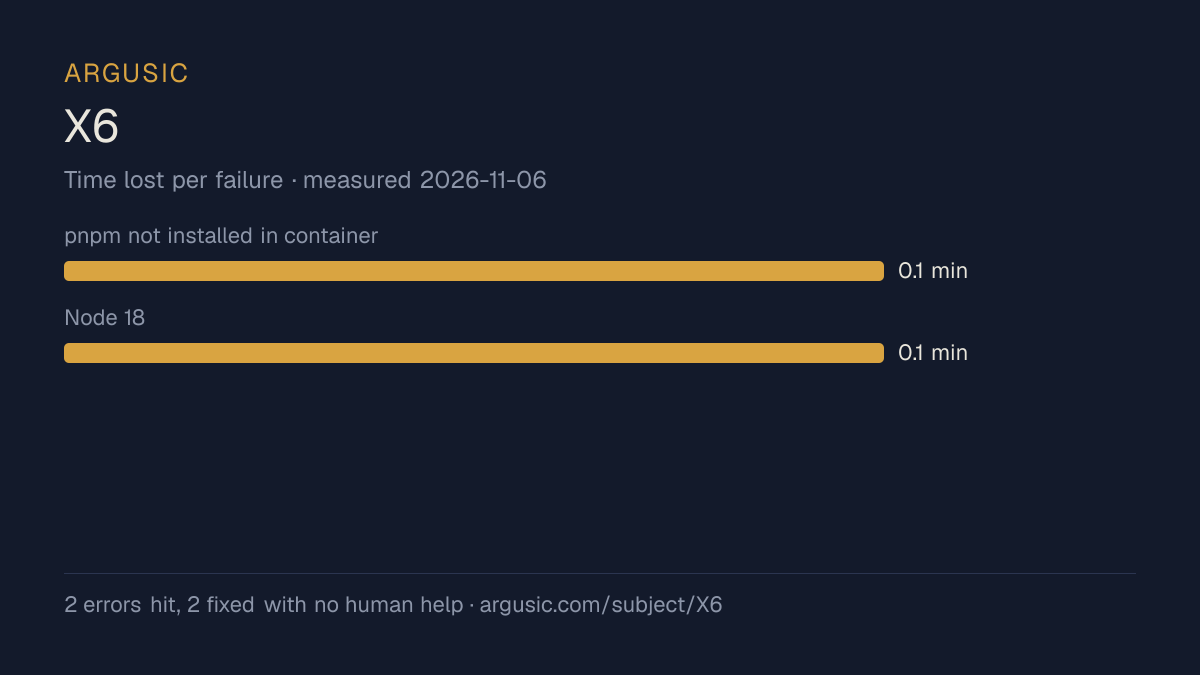
What went wrong, in the agent's own words
The agent's own words, worst first, never rewritten into advice.
- pnpm not installed in container0.1 minutes
- Node 18 (below required >=20) blocked pretest script0.1 minutes
- Install time
- 2 minutes
- Cold machine to finish
- 3 minutes
- Errors hit and fixed
- 2 hit, 2 fixed with no human help
- How the result was proved
- npx vitest --watch=false exited 0, 202 test files, 3039 tests passed
- Model tokens used
- 20,858
- Exact commit tested
- b418cb55c624
- Container image
- sha256:cdd920bce783
What was not measured
The other half, so you can see exactly how far this evidence goes. A gap is printed as a gap and never filled in.
- Peak GPU memory
- this ran on a CPU machine, so there was no GPU to sample
- Behaviour over a long run
- each attempt uses the smallest documented settings and a fixed time budget, so this measures whether it runs, not how it holds up under load
The end of the recording
The last lines of the terminal session that decided this verdict, exactly as they were recorded.
es/:
total 56
drwxrwxr-x 15 runner runner 4096 Nov  6 12:44 .
drwxr-xr-x 14 runner runner 4096 Nov  6 12:44 ..
drwxrwxr-x 23 runner runner 4096 Nov  6 12:44 common
drwxrwxr-x  2 runner runner   76 Nov  6 12:44 config
drwxrwxr-x  2 runner runner   76 Nov  6 12:44 constants
drwxrwxr-x  3 runner runner 4096 Nov  6 12:44 geometry
All 202 test files / 3039 tests passed, build completed, and install worked end-to-end. Here's the …
tokens used
20,858
All 202 test files / 3039 tests passed, build completed, and install worked end-to-end. Here's the …
Replay the whole session, every command from a clean machine to this point.
How it was tested
One agent, one container, no human help. It installs the project the way its own documentation says to, runs it, and fixes what breaks. Everything below is recorded as it happened: the terminal session, the log and the exact commit. The full method.
Strengths and limits
Measured facts, not opinions. How this is written.
What went well
- Reached a running state on a clean machine, with the session recorded.
- Installed in 1.5 minutes.
- Recovered from all 2 errors without a human stepping in, which says the failures are documented well enough to solve.
- Ran without a GPU, so it does not need one to start.
- Licensed MIT, as reported by its host.
- Measured 2 times, so the result is not a one-off.
What it is a reasonable choice for
- Trying it on a laptop or a small server: it reached a running state without a GPU.
- A quick evaluation: it was running 1.5 minutes after the clone.
Also tested, in the same area
Every one of these was installed and run by Argusic on a clean machine. Nothing appears here that was not tested.
Run history
Topics (from GitHub)
antvdagdiagramdiagrammingerderdiagramflowchartgraphgraph-editorjavascriptjavascript-diagramming-librarysvgtypescriptuml-diagram
Embed the badge
Markdown for the project README. It links back here; terms on the terms page.
[](https://argusic.com/subject/x6)Questions
- Does X6 run?
- Yes. X6 runs. Argusic installed and launched it on a clean machine in 2 minutes, hitting 2 errors on the way, and recorded the session.
- How did Argusic test X6?
- On a fresh, disposable machine, with every command recorded and the repository pinned at commit b418cb55c624. 2 attempts are recorded, and the full method is on the methodology page.
- What did it cost to test X6?
- The run that produced this verdict cost $0.02: real compute and model cost, not a list price per million tokens. It is recorded on that run's page.
- How long does X6 take to install?
- 1.5 minutes in the run that decided this verdict, from a clean machine to a running state. That is one measured attempt, not an average.
- Does X6 need a GPU?
- Not to start. Argusic reached a running state on a machine with no GPU.
- What goes wrong when installing X6?
- 2 things broke in the recorded run, and 2 were fixed without human help. Each one, and the time it cost, is listed on this page.
- Where is the evidence for X6?
- All 2 recorded runs are on this page, each linking to its full log and terminal recording, stored with a sha256 fingerprint so it cannot be quietly altered.