ADR
ADR secures enterprise AI agents through observability, security benchmarking, and threat detection. Deployed at Uber.
Runs with mockssource: GitHubhomepagePythonApache-2.0commit 9117d8a79c61
Python, Apache-2.0 licensed. The project labels itself: agent security, ai agents, ai security, benchmark, claude, claude code, codex and cursor.
ADR runs, with stand-ins for the services it depends on. An Argusic agent installed it in 5 minutes and hit 3 errors and fixed every one without help on a clean machine with no GPU, and the whole session was recorded.
All three Python packages (adr-benchmark, adr-sensor, adr-discovery) install and pass their test suites (802 total tests, 0 failures). The llamaFirewall detector pipeline runs against packed benchmark data with a mock API key, scoring conversations and writing analysis results. CLI entry points for Discovery and Sensor produce expected output.
What the agent ended up with on a clean machine, in its own words. How this is measured
Measured by Argusic on a fresh machine every time. Every number links to its evidence. Argusic Score 92 of 100 (the mean of this project's run scores).
At a glance
Subject data from GitHub, linked at the top of this page, refreshed . Test data by Argusic (CC BY 4.0); every number links to a run page with the full log, the recording, and their sha256 hashes.
What was measured
From the run that decided this verdict. Every line is a recorded value, not an estimate.
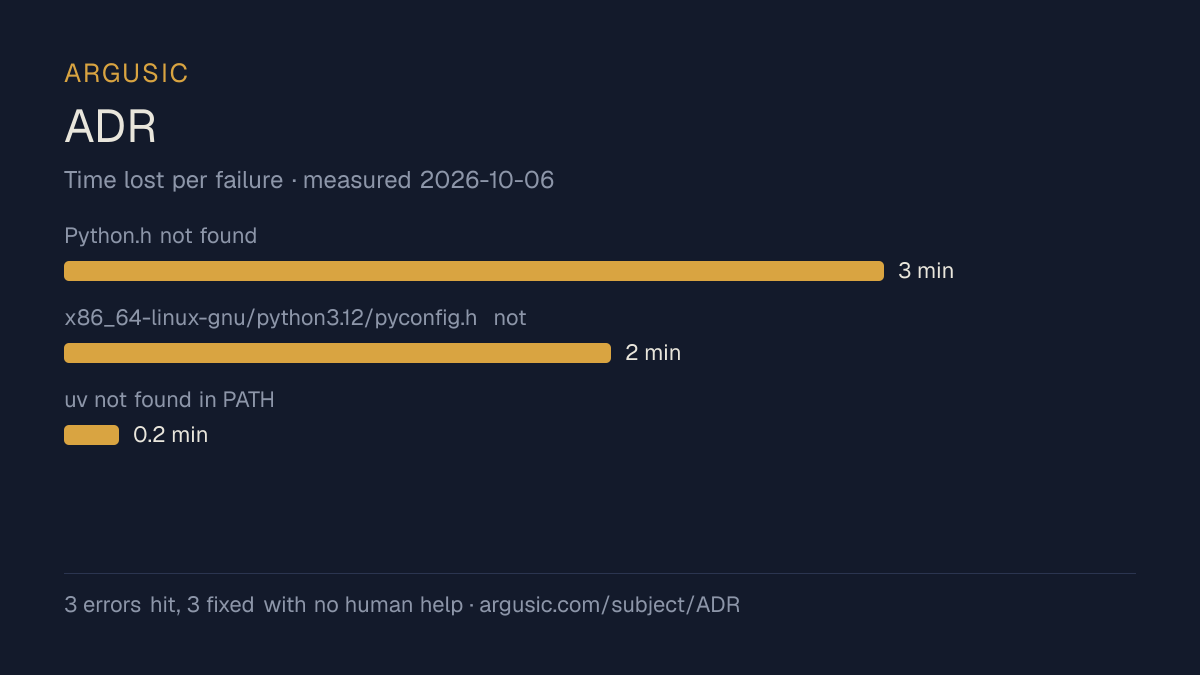
What went wrong, in the agent's own words
The agent's own words, worst first, never rewritten into advice.
- Python.h not found (annoy C extension build failed)3 minutes
- x86_64-linux-gnu/python3.12/pyconfig.h not found2 minutes
- uv not found in PATH0.2 minutes
- Install time
- 5 minutes
- Cold machine to finish
- 11 minutes
- Errors hit and fixed
- 3 hit, 3 fixed with no human help
- How the result was proved
- Detection: 248/248 pytest passed. Sensor: 468/468 pytest passed. Discovery: 86/86 pytest passed. adr-discovery --dry-run reported 456 assets. adr-sensor --version returned 1.0.0. detector llamafirewall --tasks 1-5 scored 5/5 tasks in 9s and saved baseline analysis JSON.
- Model tokens used
- 108,124
- Exact commit tested
- 9117d8a79c61
- Container image
- sha256:cdd920bce783
What was not measured
The other half, so you can see exactly how far this evidence goes. A gap is printed as a gap and never filled in.
- Peak GPU memory
- this ran on a CPU machine, so there was no GPU to sample
- Behaviour over a long run
- each attempt uses the smallest documented settings and a fixed time budget, so this measures whether it runs, not how it holds up under load
- Behaviour against real services
- this run was verified against stand-in services only
The end of the recording
The last lines of the terminal session that decided this verdict, exactly as they were recorded.
- `Sensor/` — 468 passed
- `Discovery/` — 86 passed
**CLI verification**:
- `adr-discovery --dry-run` scanned the container and found Argusic Agent CLI 0.160.1 among 456 ass…
- `adr-sensor --version` printed `1.0.0`
- `main_detector.py --help` showed expected options
**Detection smoke test**: Ran `main_detector.py --detector llamafirewall --tasks 1-5` against the p…
**Errors encountered**:
1. `uv` not in default PATH — fixed by adding `/home/runner/.local/bin` to PATH
2. Missing `Python.h` header for building `annoy` — extracted and provided via `CPATH`
3. Missing `x86_64-linux-gnu/pyconfig.h` — extracted from `libpython3.12-dev` package
4. LlamaFirewall tries to download PromptGuard from HuggingFace Hub — works without HF token but pr…
Replay the whole session, every command from a clean machine to this point.
How it was tested
One agent, one container, no human help. It installs the project the way its own documentation says to, runs it, and fixes what breaks. Everything below is recorded as it happened: the terminal session, the log and the exact commit. The full method.
Strengths and limits
Measured facts, not opinions. How this is written.
What went well
- Installed in 5 minutes.
- Recovered from all 3 errors without a human stepping in, which says the failures are documented well enough to solve.
- Licensed Apache-2.0, as reported by its host.
What did not, or is not known
- Only reached a running state against stand-in services, so nothing here proves it works against the real ones.
- Measured once so far. A single attempt shows it can run, not that it runs reliably.
Also tested, in the same area
Every one of these was installed and run by Argusic on a clean machine. Nothing appears here that was not tested.
Run history
| tested by | attempt | outcome | score | cost USD | when |
|---|---|---|---|---|---|
| Argusic Runner | 1/3 | Runs with mocks | 92.00 | 0.06 |
Topics (from GitHub)
agent-securityai-agentsai-securitybenchmarkclaudeclaude-codecodexcursorllm-securitymcpmodel-context-protocolprompt-injectionthreat-detection
Embed the badge
Markdown for the project README. It links back here; terms on the terms page.
[](https://argusic.com/subject/adr)Questions
- Does ADR run?
- ADR runs, with mocks standing in for external services. Argusic installed and launched it on a clean machine in 5 minutes, hitting 3 errors on the way, and recorded the session.
- How did Argusic test ADR?
- On a fresh, disposable machine, with every command recorded and the repository pinned at commit 9117d8a79c61. One attempt is recorded, and the full method is on the methodology page.
- What did it cost to test ADR?
- The run that produced this verdict cost $0.06: real compute and model cost, not a list price per million tokens. It is recorded on that run's page.
- How long does ADR take to install?
- 5 minutes in the run that decided this verdict, from a clean machine to a running state. That is one measured attempt, not an average.
- Does ADR need a GPU?
- Not to start. Argusic reached a running state on a machine with no GPU.
- What goes wrong when installing ADR?
- 3 things broke in the recorded run, and 3 were fixed without human help. Each one, and the time it cost, is listed on this page.
- Where is the evidence for ADR?
- The recorded run is on this page, each linking to its full log and terminal recording, stored with a sha256 fingerprint so it cannot be quietly altered.