tplay
A terminal ASCII media player. View images, gifs, videos, webcam, YouTube, etc.. directly in the terminal as ASCII art.
Runssource: GitHubRustMITcommit c62dca0da169
Rust, MIT licensed. The project labels itself: ascii, ascii art, media player and terminal.
tplay runs. An Argusic agent installed it in 26 minutes and hit 5 errors and fixed every one without help on a clean machine with no GPU, and the whole session was recorded.
tplay 0.10.0 builds, its 24-test suite passes, and it plays local MP4/PNG media as truecolor ASCII in the terminal, exiting cleanly on q.
What the agent ended up with on a clean machine, in its own words. How this is measured
Measured by Argusic on a fresh machine every time. Every number links to its evidence. Argusic Score 100 of 100 (the mean of this project's run scores).
At a glance
Subject data from GitHub, linked at the top of this page, refreshed . Test data by Argusic (CC BY 4.0); every number links to a run page with the full log, the recording, and their sha256 hashes.
What was measured
From the run that decided this verdict. Every line is a recorded value, not an estimate.
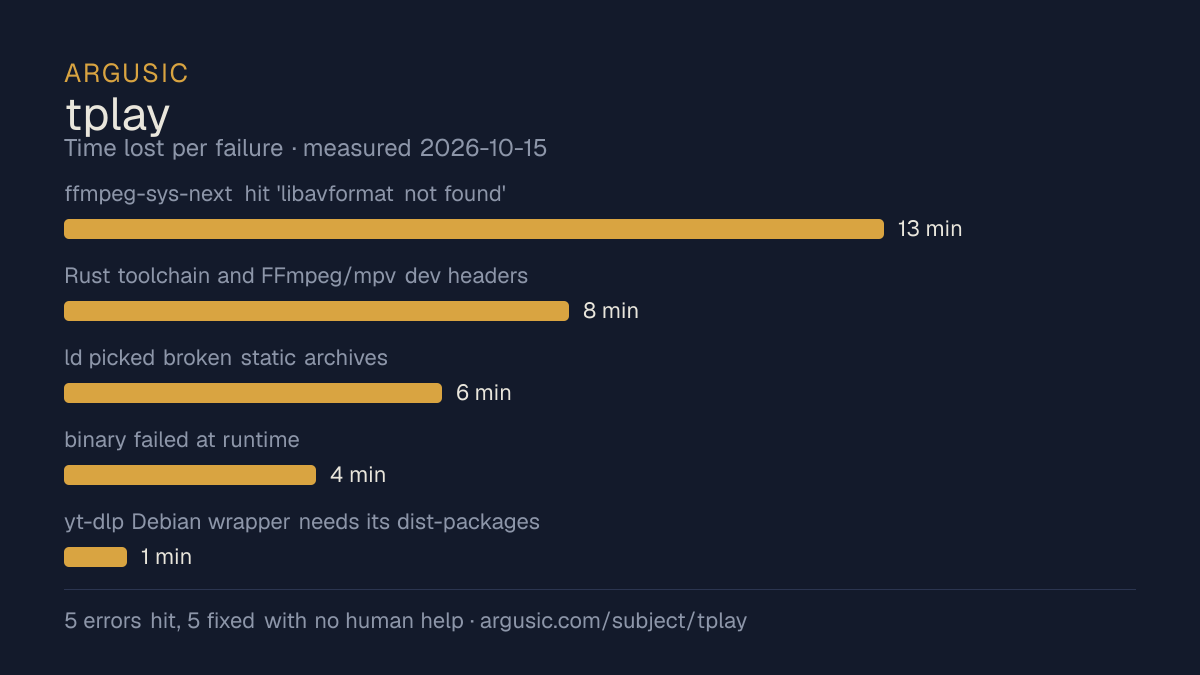
What went wrong, in the agent's own words
The agent's own words, worst first, never rewritten into advice.
- ffmpeg-sys-next hit 'libavformat not found' then 'limits.h not found' during bindgen13 minutes
- Rust toolchain and FFmpeg/mpv dev headers absent (no root); pkg-config found no libavformat8 minutes
- ld picked broken static archives; undefined MFX/OpenCL symbols6 minutes
- binary failed at runtime: libdvdnav/libmujs/liblua5.2/libsixel/libXpresent/libva-wayland missing4 minutes
- yt-dlp Debian wrapper needs its dist-packages1 minute
- Install time
- 26 minutes
- Cold machine to finish
- 26 minutes
- Errors hit and fixed
- 5 hit, 5 fixed with no human help
- How the result was proved
- cargo build --release finished (release binary 12.2MB, tplay 0.10.0); cargo test printed 'test result: ok. 24 passed; 0 failed'; script PTY run on /tmp/test.mp4 at 100x40 for 10s then q exited rc 0 and emitted 346,099 body bytes with 22,350 visible ASCII cells and 19,048 truecolor SGR sequences; ffmpeg -v error -i /tmp/test.mp4 -f null - decoded cleanly
- Model tokens used
- 1,788,222
- Exact commit tested
- c62dca0da169
- Container image
- sha256:cdd920bce783
What was not measured
The other half, so you can see exactly how far this evidence goes. A gap is printed as a gap and never filled in.
- Peak GPU memory
- this ran on a CPU machine, so there was no GPU to sample
- Behaviour over a long run
- each attempt uses the smallest documented settings and a fixed time budget, so this measures whether it runs, not how it holds up under load
The end of the recording
The last lines of the terminal session that decided this verdict, exactly as they were recorded.
Usage: tplay [OPTIONS] <INPUT>
=== media decoded? ===
media decode: OK
exec
/bin/sh -lc 'date -u +%Y-%m-%dT%H:%M:%SZ; echo "elapsed estimate: started ~04:26, now ~04:52 => ~26…
 succeeded in 0ms:
2026-10-15T04:51:40Z
elapsed estimate: started ~04:26, now ~04:52 => ~26 min
Everything is verified and the environment is fully built. Final report.
tokens used
1,788,222
Everything is verified and the environment is fully built. Final report.
Replay the whole session, every command from a clean machine to this point.
How it was tested
One agent, one container, no human help. It installs the project the way its own documentation says to, runs it, and fixes what breaks. Everything below is recorded as it happened: the terminal session, the log and the exact commit. The full method.
Strengths and limits
Measured facts, not opinions. How this is written.
What went well
- Reached a running state on a clean machine, with the session recorded.
- Recovered from all 5 errors without a human stepping in, which says the failures are documented well enough to solve.
- Ran without a GPU, so it does not need one to start.
- Licensed MIT, as reported by its host.
What did not, or is not known
- Took 26 minutes to install, slower than the median of the 4 comparable projects Argusic has measured.
- Measured once so far. A single attempt shows it can run, not that it runs reliably.
Of the 5 ascii projects Argusic has installed and timed, tplay was the 5th fastest to reach a running state, and 5 of 5 reached one at all.
What it is a reasonable choice for
- Trying it on a laptop or a small server: it reached a running state without a GPU.
Also tested, in the same area
Every one of these was installed and run by Argusic on a clean machine. Nothing appears here that was not tested.
Run history
Topics (from GitHub)
Embed the badge
Markdown for the project README. It links back here; terms on the terms page.
[](https://argusic.com/subject/tplay)Questions
- Does tplay run?
- Yes. tplay runs. Argusic installed and launched it on a clean machine in 26 minutes, hitting 5 errors on the way, and recorded the session.
- How did Argusic test tplay?
- On a fresh, disposable machine, with every command recorded and the repository pinned at commit c62dca0da169. One attempt is recorded, and the full method is on the methodology page.
- What did it cost to test tplay?
- The run that produced this verdict cost $0.38: real compute and model cost, not a list price per million tokens. It is recorded on that run's page.
- How long does tplay take to install?
- 26 minutes in the run that decided this verdict, from a clean machine to a running state. That is one measured attempt, not an average.
- Does tplay need a GPU?
- Not to start. Argusic reached a running state on a machine with no GPU.
- What goes wrong when installing tplay?
- 5 things broke in the recorded run, and 5 were fixed without human help. Each one, and the time it cost, is listed on this page.
- How does tplay compare with the alternatives?
- Of the 5 ascii projects Argusic has installed and timed, tplay was the 5th fastest to reach a running state, and 5 of 5 reached one at all.
- Where is the evidence for tplay?
- The recorded run is on this page, each linking to its full log and terminal recording, stored with a sha256 fingerprint so it cannot be quietly altered.