RuView
π RuView turns commodity WiFi signals into real-time spatial intelligence, vital sign monitoring, and presence detection, all without a single pixel of video.
Runssource: GitHubhomepageRustMITcommit dd02efe2fe12
Rust, MIT licensed. The project labels itself: awesome, claude, densepose, esp32, firmware, home assistant, home automation and iot.
RuView runs. An Argusic agent installed it in 32 minutes and hit 7 errors on a clean machine with no GPU, and the whole session was recorded.
Python deterministic verification pipeline runs and produces a bit-identical SHA-256 hash; 46 Python unit tests pass; 93 RuView harness tests pass; 27 Homecore harness tests pass; 42 Rust core+utility tests pass; Rust full workspace cannot compile due to system library dependencies (glib); no hardware available for CSI capture
What the agent ended up with on a clean machine, in its own words. How this is measured
Measured by Argusic on a fresh machine every time. Every number links to its evidence. Argusic Score 94.3 of 100 (the mean of this project's run scores).
At a glance
Subject data from GitHub, linked at the top of this page, refreshed . Test data by Argusic (CC BY 4.0); every number links to a run page with the full log, the recording, and their sha256 hashes.
What was measured
From the run that decided this verdict. Every line is a recorded value, not an estimate.
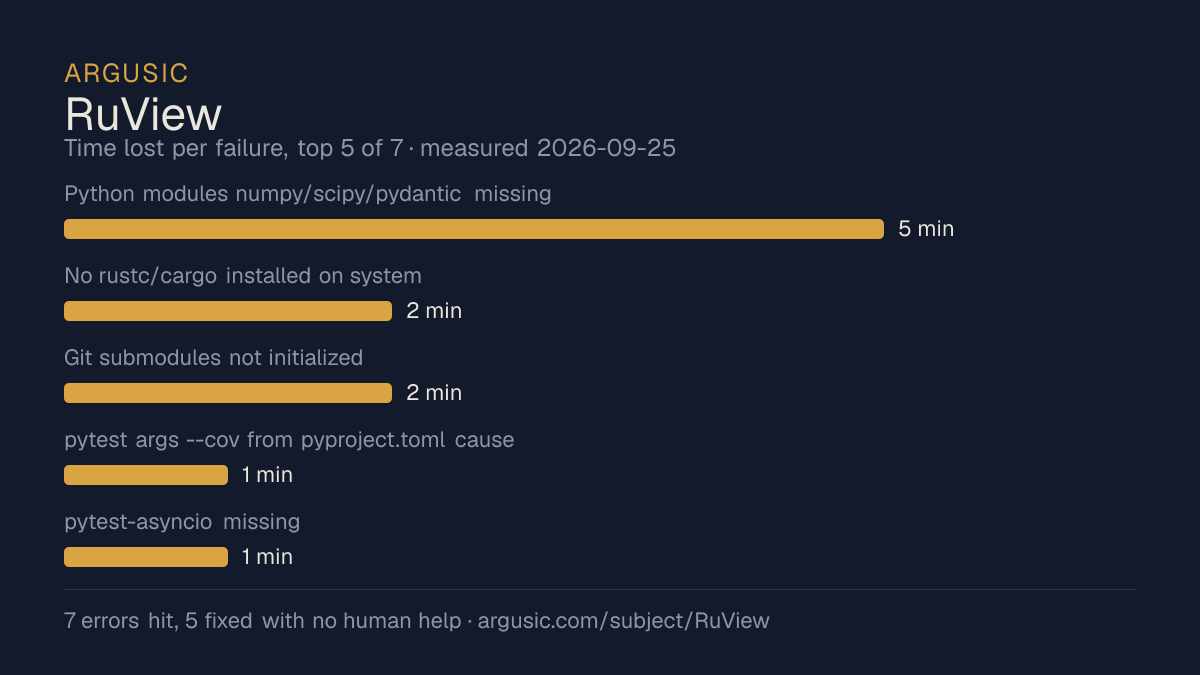
What went wrong, in the agent's own words
The agent's own words, worst first, never rewritten into advice.
- Python modules numpy/scipy/pydantic missing5 minutes
- No rustc/cargo installed on system2 minutes
- Git submodules not initialized (vendor/rufield etc missing)2 minutes
- pytest args --cov from pyproject.toml cause unrecognized argument error1 minute
- pytest-asyncio missing: async tests fail1 minute
- Rust workspace build fails on glib-sys system library dependency (sensing-server crate chain)
- Install time
- 32 minutes
- Cold machine to finish
- 36 minutes
- Errors hit and fixed
- 7 hit, 5 fixed with no human help
- How the result was proved
- python3 archive/v1/data/proof/verify.py returned VERDICT: PASS with SHA-256 match f8e76f21...; npm test in harness/ruview returned 93 passed; npm test in harness/homecore returned 27 passed; python3 -m pytest tests/unit/test_csi_standalone.py tests/unit/test_csi_processor.py returned 46 passed; cargo test -p wifi-densepose-core returned 39+3 passed
- Model tokens used
- 782,465
- Exact commit tested
- dd02efe2fe12
- Container image
- sha256:cdd920bce783
What was not measured
The other half, so you can see exactly how far this evidence goes. A gap is printed as a gap and never filled in.
- Peak GPU memory
- this ran on a CPU machine, so there was no GPU to sample
- Behaviour over a long run
- each attempt uses the smallest documented settings and a fixed time budget, so this measures whether it runs, not how it holds up under load
The end of the recording
The last lines of the terminal session that decided this verdict, exactly as they were recorded.
- Missing Rust → installed via rustup
- Missing submodules → `git submodule update --init --recursive`
- Missing Python packages → venv + pip
- Pytest config errors → overrode with `-o "addopts="`
**Issues unabled to fix:**
- Rust full workspace: `glib-sys` requires system library not availabe without root; crates chain f…
- `wifi-densepose-signal` hangs on compilation (he avy nalgebra/simba dependency tree)
- Python integration & API tests require torch + fastapi (too heavy to install)
**Not tested:**
- No ESP32 hardware for real CSI capture
- No Docker (no daemon)
- `./verify` script's cargo/docker phases blocked
Replay the whole session, every command from a clean machine to this point.
How it was tested
One agent, one container, no human help. It installs the project the way its own documentation says to, runs it, and fixes what breaks. Everything below is recorded as it happened: the terminal session, the log and the exact commit. The full method.
Strengths and limits
Measured facts, not opinions. How this is written.
What went well
- Reached a running state on a clean machine, with the session recorded.
- Installed in 32 minutes.
- Ran without a GPU, so it does not need one to start.
- Licensed MIT, as reported by its host.
What did not, or is not known
- Hit 7 errors during setup, 2 of which were not solved.
- Measured once so far. A single attempt shows it can run, not that it runs reliably.
What it is a reasonable choice for
- Trying it on a laptop or a small server: it reached a running state without a GPU.
Also tested, in the same area
Every one of these was installed and run by Argusic on a clean machine. Nothing appears here that was not tested.
Run history
Topics (from GitHub)
awesomeclaudedenseposeesp32firmwarehome-assistanthome-automationiotmonitoringnetworkingnpmpose-estimationreactrfself-learningskillsspatial-intelligencetypescriptwifiwifi-security
Embed the badge
Markdown for the project README. It links back here; terms on the terms page.
[](https://argusic.com/subject/ruview)Questions
- Does RuView run?
- Yes. RuView runs. Argusic installed and launched it on a clean machine in 32 minutes, hitting 7 errors on the way, and recorded the session.
- How did Argusic test RuView?
- On a fresh, disposable machine, with every command recorded and the repository pinned at commit dd02efe2fe12. One attempt is recorded, and the full method is on the methodology page.
- What did it cost to test RuView?
- The run that produced this verdict cost $0.15: real compute and model cost, not a list price per million tokens. It is recorded on that run's page.
- How long does RuView take to install?
- 32 minutes in the run that decided this verdict, from a clean machine to a running state. That is one measured attempt, not an average.
- Does RuView need a GPU?
- Not to start. Argusic reached a running state on a machine with no GPU.
- What goes wrong when installing RuView?
- 7 things broke in the recorded run, and 5 were fixed without human help. Each one, and the time it cost, is listed on this page.
- Where is the evidence for RuView?
- The recorded run is on this page, each linking to its full log and terminal recording, stored with a sha256 fingerprint so it cannot be quietly altered.