radient
Radient turns many data types (not just text) into vectors for similarity search, RAG, regression analysis, and more.
Runssource: GitHubPythonBSD-2-Clausecommit 89ee872edd6b
Python, BSD-2-Clause licensed. The project labels itself: audio, embeddings, etl, fraud detection, graphs, image search, images and milvus.
radient runs. An Argusic agent installed it in 15 minutes and hit 7 errors and fixed every one without help on a clean machine with no GPU, and the whole session was recorded.
Installs under virtualenv. All 5 vectorizer backends produce correct embeddings. GANN C extension compiles and searches. Workflows run. ffmpeg demux produces decodable media. accelerate() broken on modern torch/transformers.
What the agent ended up with on a clean machine, in its own words. How this is measured
Measured by Argusic on a fresh machine every time. Every number links to its evidence. Argusic Score 100 of 100 (the mean of this project's run scores).
At a glance
Subject data from GitHub, linked at the top of this page, refreshed . Test data by Argusic (CC BY 4.0); every number links to a run page with the full log, the recording, and their sha256 hashes.
What was measured
From the run that decided this verdict. Every line is a recorded value, not an estimate.
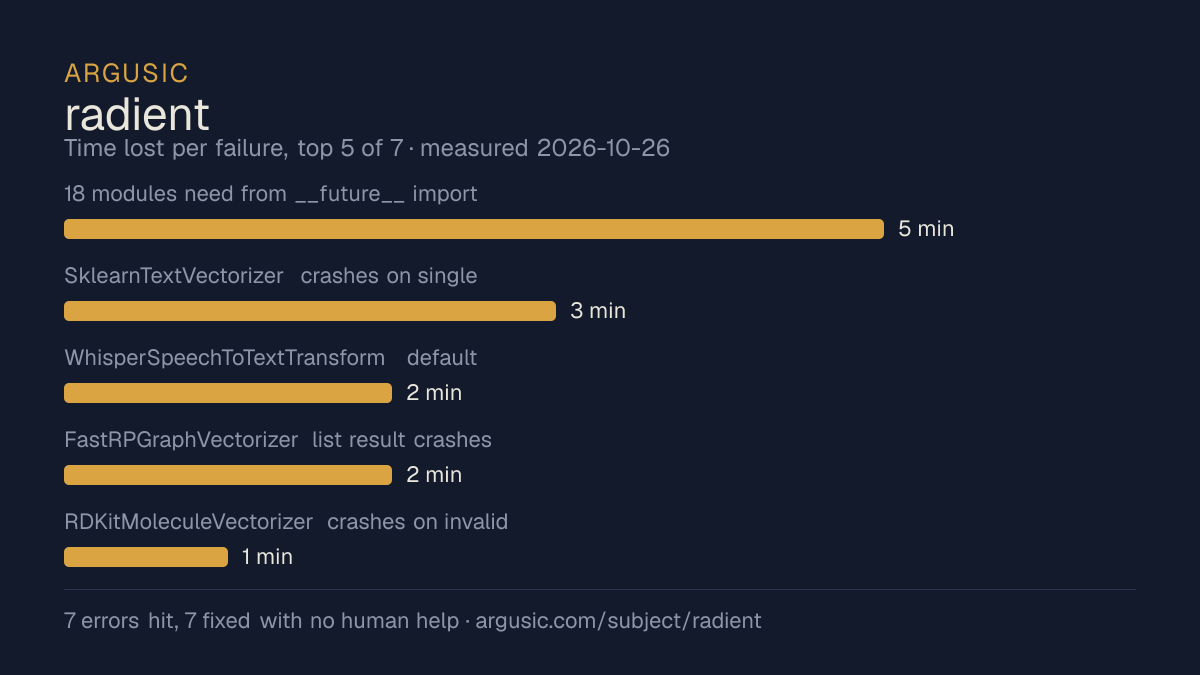
What went wrong, in the agent's own words
The agent's own words, worst first, never rewritten into advice.
- 18 modules need from __future__ import annotations to prevent eager LazyImport at class-definition time5 minutes
- SklearnTextVectorizer crashes on single string and missing fit3 minutes
- WhisperSpeechToTextTransform default torch_dtype eagerly evaluates LazyImport2 minutes
- FastRPGraphVectorizer list result crashes metadata attachment2 minutes
- RDKitMoleculeVectorizer crashes on invalid SMILES from FDA dataset1 minute
- DefaultVideoDemuxTransform cannot decode AAC/mp4 via librosa+soundfile
- Install time
- 15 minutes
- Cold machine to finish
- 25 minutes
- Errors hit and fixed
- 7 hit, 7 fixed with no human help
- How the result was proved
- text(sbert) returned (384,) float32; text(sklearn) returned (1,2) int64; graph returned 34 vectors of (64,); molecule returned (2048,) bool; audio returned (768,) float32. Drug-discovery top-10 matches match README. GANN C library compiles and search finds nearest neighbor at distance ~0. Workflow orchestration runs. ffmpeg demux produces decodable frames and audio.
- Model tokens used
- 1,326,982
- Exact commit tested
- 89ee872edd6b
- Container image
- sha256:cdd920bce783
What was not measured
The other half, so you can see exactly how far this evidence goes. A gap is printed as a gap and never filled in.
- Peak GPU memory
- this ran on a CPU machine, so there was no GPU to sample
- Behaviour over a long run
- each attempt uses the smallest documented settings and a fixed time budget, so this measures whether it runs, not how it holds up under load
The end of the recording
The last lines of the terminal session that decided this verdict, exactly as they were recorded.
- `text_vectorizer()` → `(384,) float32` Vector for "Hello, world!"
- `text_vectorizer(method="sklearn")` → `(1, 2) int64`
- `graph_vectorizer()` on Karate Club → 34 × `(64,)` node embeddings
- `molecule_vectorizer()` on `O=C=O` → `(2048,) bool`
- `audio_vectorizer(method="torchaudio", model_name="HUBERT_BASE")` on generated wav → `(768,) floa…
- Drug-discovery example → exact README top-10 (Dexibuprofen...Oxeladin)
- GANN C extension compiled with `make`, index built, search returns true nearest neighbor
- Workflow orchestration (source → vectorize) executed
- ffmpeg demux transform produced frames/wavs that all decode with `ffmpeg -v error -i FILE -f null…
**Remaining unfixed gaps** (documented):
- `accelerate()` broken with modern torch/transformers (ONNX exporter can't ingest `BatchEncoding`).
- Default opencv video demux can't extract audio from mp4 (librosa/soundfile limitation); ffmpeg me…
Replay the whole session, every command from a clean machine to this point.
How it was tested
One agent, one container, no human help. It installs the project the way its own documentation says to, runs it, and fixes what breaks. Everything below is recorded as it happened: the terminal session, the log and the exact commit. The full method.
Strengths and limits
Measured facts, not opinions. How this is written.
What went well
- Reached a running state on a clean machine, with the session recorded.
- Recovered from all 7 errors without a human stepping in, which says the failures are documented well enough to solve.
- Ran without a GPU, so it does not need one to start.
- Licensed BSD-2-Clause, as reported by its host.
What did not, or is not known
- Took 15 minutes to install, slower than the median of the 17 comparable projects Argusic has measured.
- Measured once so far. A single attempt shows it can run, not that it runs reliably.
Of the 18 audio projects Argusic has installed and timed, radient was the 14th fastest to reach a running state, and 15 of 18 reached one at all.
What it is a reasonable choice for
- Trying it on a laptop or a small server: it reached a running state without a GPU.
Also tested, in the same area
Every one of these was installed and run by Argusic on a clean machine. Nothing appears here that was not tested.
Run history
Topics (from GitHub)
audioembeddingsetlfraud-detectiongraphsimage-searchimagesmilvusmolecular-searchmoleculesmultimodal-ragrecommender-systemretrieval-augmented-generationsemantic-searchsimilarity-searchtextunstructured-dataunstructured-data-processingvector-databasevectors
Embed the badge
Markdown for the project README. It links back here; terms on the terms page.
[](https://argusic.com/subject/radient)Questions
- Does radient run?
- Yes. radient runs. Argusic installed and launched it on a clean machine in 15 minutes, hitting 7 errors on the way, and recorded the session.
- How did Argusic test radient?
- On a fresh, disposable machine, with every command recorded and the repository pinned at commit 89ee872edd6b. One attempt is recorded, and the full method is on the methodology page.
- What did it cost to test radient?
- The run that produced this verdict cost $0.29: real compute and model cost, not a list price per million tokens. It is recorded on that run's page.
- How long does radient take to install?
- 15 minutes in the run that decided this verdict, from a clean machine to a running state. That is one measured attempt, not an average.
- Does radient need a GPU?
- Not to start. Argusic reached a running state on a machine with no GPU.
- What goes wrong when installing radient?
- 7 things broke in the recorded run, and 7 were fixed without human help. Each one, and the time it cost, is listed on this page.
- How does radient compare with the alternatives?
- Of the 18 audio projects Argusic has installed and timed, radient was the 14th fastest to reach a running state, and 15 of 18 reached one at all.
- Where is the evidence for radient?
- The recorded run is on this page, each linking to its full log and terminal recording, stored with a sha256 fingerprint so it cannot be quietly altered.