Krawl
Krawl is a customizable, lightweight, cloud-native web deception server and anti-crawler that creates fake web applications with low-hanging vulnerabilities using realistic, randomly generated decoy data and AI-generated HTML templates.
Could not verifysource: GitHubhomepagePythonMITcommit 5b37247c4950
Python, MIT licensed. The project labels itself: ai, ai security, alerting, anti crawling, blue team, cloud native, crawler and cybersecurity.
Argusic could not get Krawl running. An Argusic agent installed it in 40 minutes and hit 5 errors and fixed every one without help on a clean machine with no GPU, and the whole session was recorded.
Krawl installs in a venv (minus py-tlsh), runs via uvicorn serving 200s on /das_dashboard, /das_dashboard/metrics and honeypot pages, captures posted credentials into the dashboard/SQLite, auto-classifies the IP 'attacker', and passes its 75-test pytest suite.
What the agent ended up with on a clean machine, in its own words. How this is measured
Measured by Argusic on a fresh machine every time. Every number links to its evidence. Argusic Score 20 of 100 (the mean of this project's run scores).
At a glance
Subject data from GitHub, linked at the top of this page, refreshed . Test data by Argusic (CC BY 4.0); every number links to a run page with the full log, the recording, and their sha256 hashes.
What was measured
From the run that decided this verdict. Every line is a recorded value, not an estimate.
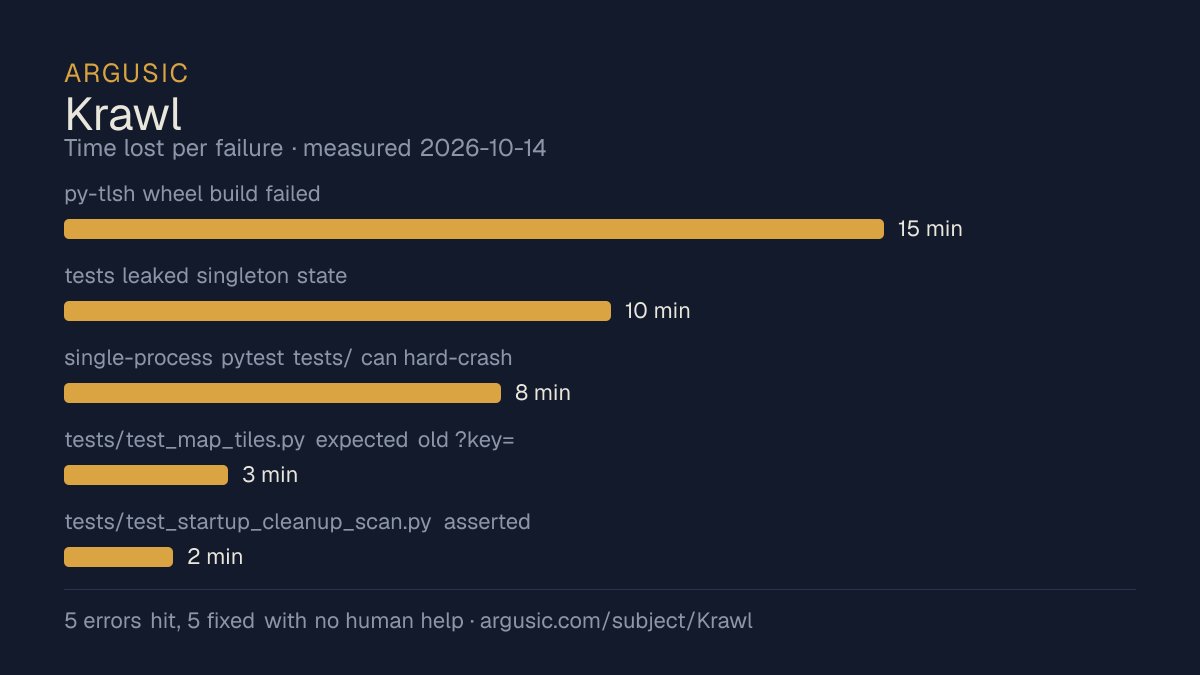
What went wrong, in the agent's own words
The agent's own words, worst first, never rewritten into advice.
- py-tlsh wheel build failed: missing Python.h (python3-dev not installed, no root); no prebuilt cp312 wheel on PyPI15 minutes
- tests leaked singleton state (dashboard_cache backend, config, DatabaseManager) across files, making later tests fail (FakeRedis.set(nx=..), no such table, server-IP 204->200)10 minutes
- single-process pytest tests/ can hard-crash the interpreter (bus error in aiohttp/frozenlist C extensions) before printing a summary8 minutes
- tests/test_map_tiles.py expected old ?key= param, code now emits ?api_key=3 minutes
- tests/test_startup_cleanup_scan.py asserted removed == 2 but purge_ignored_ips returns total rows deleted across tables2 minutes
- Install time
- 40 minutes
- Cold machine to finish
- 36 minutes
- Errors hit and fixed
- 5 hit, 5 fixed with no human help
- How the result was proved
- pytest tests/ -q -p no:cacheprovider -> '75 passed, 3 warnings in 82.29s'; curl -s -o /dev/null -w %{http_code} http://127.0.0.1:5000/das_dashboard -> 200, /das_dashboard/metrics -> 200, honeypot page with X-Forwarded-For -> 200; POST /wp-login.php captured 'wpuser' credentials (dashboard API + SQLite row) and IP auto-classified 'attacker'
- Model tokens used
- 1,425,585
- Exact commit tested
- 5b37247c4950
- Container image
- sha256:cdd920bce783
What was not measured
The other half, so you can see exactly how far this evidence goes. A gap is printed as a gap and never filled in.
- Peak GPU memory
- this ran on a CPU machine, so there was no GPU to sample
- Behaviour over a long run
- each attempt uses the smallest documented settings and a fixed time budget, so this measures whether it runs, not how it holds up under load
The end of the recording
The last lines of the terminal session that decided this verdict, exactly as they were recorded.
        {\"msg\": \"single-process pytest tests/ can hard-crash the interpreter (bus error in aioht…
    ],
    \"test_depth\": \"tier1_real\",
    \"notes\": \"py-tlsh unavailable (missing python3-dev headers) -> TLSH clustering SKIPPED. Loop…
    \"verified_how\": \"pytest tests/ -q -p no:cacheprovider -> '75 passed, 3 warnings in 82.29s'; …
    \"final_state\": \"Krawl installs in a venv (minus py-tlsh), runs via uvicorn serving 200s on /…
}
print(\"ARGUSIC_RESULT:\" + json.dumps(r))
PY" in /work/repo
 succeeded in 0ms:
tokens used
1,425,585
Replay the whole session, every command from a clean machine to this point.
How it was tested
One agent, one container, no human help. It installs the project the way its own documentation says to, runs it, and fixes what breaks. Everything below is recorded as it happened: the terminal session, the log and the exact commit. The full method.
Strengths and limits
Measured facts, not opinions. How this is written.
What went well
- Recovered from all 5 errors without a human stepping in, which says the failures are documented well enough to solve.
- Licensed MIT, as reported by its host.
- Measured 2 times, so the result is not a one-off.
What did not, or is not known
- An agent with no time limit did not get it running.
- Took 40 minutes to install, slower than the median of the 237 comparable projects Argusic has measured.
Of the 238 ai projects Argusic has installed and timed, Krawl was the 232nd fastest to reach a running state, and 169 of 238 reached one at all.
Also tested, in the same area
Every one of these was installed and run by Argusic on a clean machine. Nothing appears here that was not tested.
Run history
| tested by | attempt | outcome | score | cost USD | when |
|---|---|---|---|---|---|
| Argusic Runner | 2/3 | Ran out of time | 0.00 | 1.58 | |
| Argusic Runner | 1/3 | Did not run | 20.00 | 0.33 |
Topics (from GitHub)
aiai-securityalertinganti-crawlingblue-teamcloud-nativecrawlercybersecuritydeceptiongrafanahoneypotkubernetesmonitoringsecurityself-hostedspiderweb
Embed the badge
Markdown for the project README. It links back here; terms on the terms page.
[](https://argusic.com/subject/krawl)Questions
- Does Krawl run?
- Argusic could not verify that Krawl runs. Argusic installed and launched it on a clean machine in 40 minutes, hitting 5 errors on the way, and recorded the session.
- How did Argusic test Krawl?
- On a fresh, disposable machine, with every command recorded and the repository pinned at commit 5b37247c4950. 2 attempts are recorded, and the full method is on the methodology page.
- What did it cost to test Krawl?
- The run that produced this verdict cost $0.33: real compute and model cost, not a list price per million tokens. It is recorded on that run's page.
- How long does Krawl take to install?
- 40 minutes in the run that decided this verdict, from a clean machine to a running state. That is one measured attempt, not an average.
- Does Krawl need a GPU?
- Not to start. Argusic reached a running state on a machine with no GPU.
- What goes wrong when installing Krawl?
- 5 things broke in the recorded run, and 5 were fixed without human help. Each one, and the time it cost, is listed on this page.
- How does Krawl compare with the alternatives?
- Of the 238 ai projects Argusic has installed and timed, Krawl was the 232nd fastest to reach a running state, and 169 of 238 reached one at all.
- Where is the evidence for Krawl?
- All 2 recorded runs are on this page, each linking to its full log and terminal recording, stored with a sha256 fingerprint so it cannot be quietly altered.