icrawler
A multi-thread crawler framework with many builtin image crawlers provided.
Runssource: GitHubhomepagePythonMITcommit f2a326dc2b07
Python, MIT licensed. The project labels itself: bing image, crawler, flickr api, google images, python, scrapy and spider.
icrawler runs. An Argusic agent installed it in 0.1 minutes and hit 3 errors and fixed every one without help on a clean machine with no GPU, and the whole session was recorded.
icrawler 0.1.dev1 installs in Python 3.12 venv, passes 5 test cases (4 real crawler smoke tests + 1 doctest), Bing and Baidu crawlers download valid JPEG/PNG images from the web after fixing 3 runtime bugs
What the agent ended up with on a clean machine, in its own words. How this is measured
Measured by Argusic on a fresh machine every time. Every number links to its evidence. Argusic Score 100 of 100 (the mean of this project's run scores).
At a glance
Subject data from GitHub, linked at the top of this page, refreshed . Test data by Argusic (CC BY 4.0); every number links to a run page with the full log, the recording, and their sha256 hashes.
What was measured
From the run that decided this verdict. Every line is a recorded value, not an estimate.
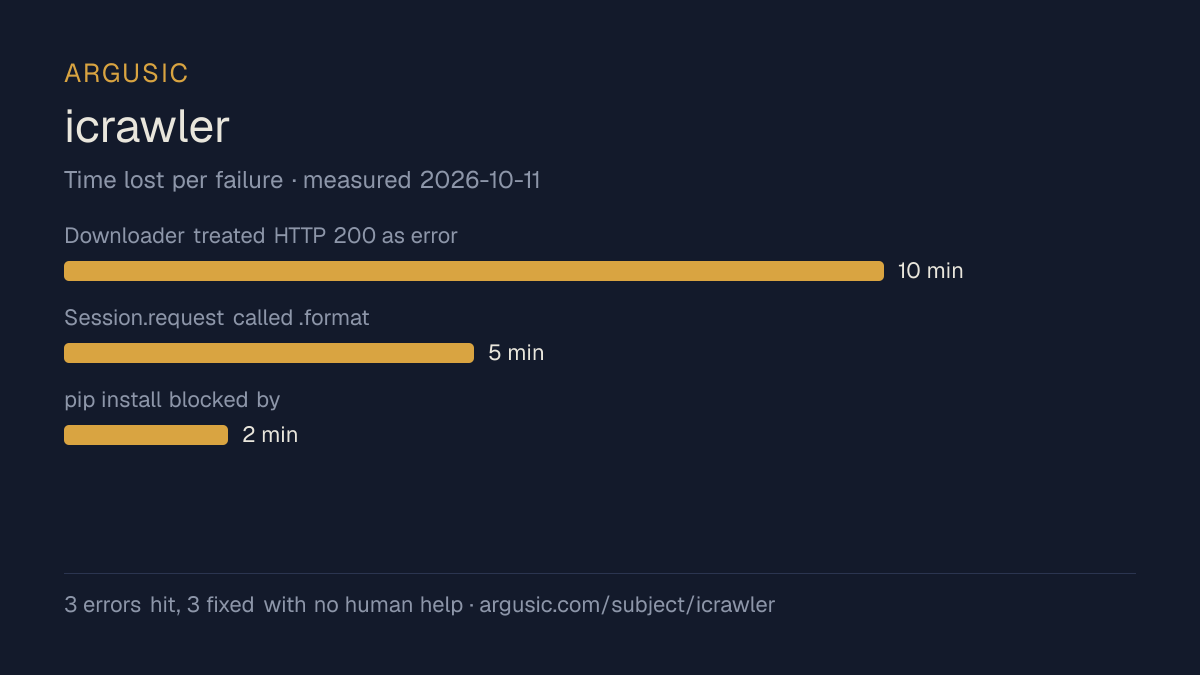
What went wrong, in the agent's own words
The agent's own words, worst first, never rewritten into advice.
- Downloader exited on HTTP 200 success without saving the file; break before storage.write()5 minutes
- Session.request() called proxy.format() on None when proxy_pool.get_next() returned None, raising AttributeError3 minutes
- Parser crashed with TypeError iterating over None when parse() returns None instead of a list1 minute
- Install time
- under a minute
- Cold machine to finish
- 12 minutes
- Errors hit and fixed
- 3 hit, 3 fixed with no human help
- How the result was proved
- pytest test_google test_bing test_baidu test_urllist icrawler/parser.py --doctest-modules -v exited 0 with 5 passed; BingImageCrawler downloaded valid images (ffmpeg validated); offline unit tests all passed
- Model tokens used
- 353,210
- Exact commit tested
- f2a326dc2b07
- Container image
- sha256:cdd920bce783
What was not measured
The other half, so you can see exactly how far this evidence goes. A gap is printed as a gap and never filled in.
- Peak GPU memory
- this ran on a CPU machine, so there was no GPU to sample
- Behaviour over a long run
- each attempt uses the smallest documented settings and a fixed time budget, so this measures whether it runs, not how it holds up under load
Watch the session
The whole run, from a clean machine, at the speed it actually happened. Nothing is cut and nothing is sped up.
A recording of attempt 2, run , the attempt that decided the verdict above. The terminal recording it was made from is the evidence, stored with a sha256 fingerprint; the video is a rendering of it. Nothing loads from the video host until you press play.
The end of the recording
The last lines of the terminal session that decided this verdict, exactly as they were recorded.
tokens used
353,210
The full result has been output as the last line. To recap what was done:
**Install**: Created a venv, `pip install -e .` succeeded.
**Bugs found and fixed** (3):
1. **`session.py`**: `proxy.format()` called on `None` when no proxy configured — added a `None` gu…
2. **`downloader.py`**: Successfully fetched images (HTTP 200) caused an early `break` before `stor…
3. **`parser.py`**: `self.parse()` returning `None` caused `TypeError: 'NoneType' object is not ite…
**Verification**:
- 5 pytest tests pass (Google, Bing, Baidu, UrlList crawlers + parser doctest)
- Bing and Baidu crawlers download valid images (verified with `ffmpeg`)
- 10 offline unit tests pass
Replay the whole session, every command from a clean machine to this point.
How it was tested
One agent, one container, no human help. It installs the project the way its own documentation says to, runs it, and fixes what breaks. Everything below is recorded as it happened: the terminal session, the log and the exact commit. The full method.
Strengths and limits
Measured facts, not opinions. How this is written.
What went well
- Reached a running state on a clean machine, with the session recorded.
- Installed in 0.1 minutes.
- Recovered from all 3 errors without a human stepping in, which says the failures are documented well enough to solve.
- Ran without a GPU, so it does not need one to start.
- Licensed MIT, as reported by its host.
- Measured 2 times, so the result is not a one-off.
What it is a reasonable choice for
- Trying it on a laptop or a small server: it reached a running state without a GPU.
- A quick evaluation: it was running 0.1 minutes after the clone.
Also tested, in the same area
Every one of these was installed and run by Argusic on a clean machine. Nothing appears here that was not tested.
Run history
Topics (from GitHub)
Embed the badge
Markdown for the project README. It links back here; terms on the terms page.
[](https://argusic.com/subject/icrawler)Questions
- Does icrawler run?
- Yes. icrawler runs. Argusic installed and launched it on a clean machine in 0 minutes, hitting 3 errors on the way, and recorded the session.
- How did Argusic test icrawler?
- On a fresh, disposable machine, with every command recorded and the repository pinned at commit f2a326dc2b07. 2 attempts are recorded, and the full method is on the methodology page.
- What did it cost to test icrawler?
- The run that produced this verdict cost $0.16: real compute and model cost, not a list price per million tokens. It is recorded on that run's page.
- How long does icrawler take to install?
- 0.1 minutes in the run that decided this verdict, from a clean machine to a running state. That is one measured attempt, not an average.
- Does icrawler need a GPU?
- Not to start. Argusic reached a running state on a machine with no GPU.
- What goes wrong when installing icrawler?
- 3 things broke in the recorded run, and 3 were fixed without human help. Each one, and the time it cost, is listed on this page.
- Where is the evidence for icrawler?
- All 2 recorded runs are on this page, each linking to its full log and terminal recording, stored with a sha256 fingerprint so it cannot be quietly altered.