gpt-load
Self-hosted AI gateway for multi-channel, multi-credential setups, API keys and subscription accounts, scheduling, failover, request logs and usage. 自托管 AI 网关:多渠道多凭据统一接入,含密钥与订阅账号、调度容错、日志与用量。
Runssource: GitHubhomepageGoMITcommit ae59a0ae8515
Go, MIT licensed. The project labels itself: ai gateway, anthropic, api gateway, claude, claude code, codex, gemini and gin.
gpt-load runs. An Argusic agent installed it in 10 minutes and hit 3 errors and fixed every one without help on a clean machine with no GPU, and the whole session was recorded.
GPT-Load 2.0 binary builds, web UI compiles, server starts on 127.0.0.1:3001, health endpoint returns HTTP 200, auto-generates AUTH_KEY, and shuts down gracefully with all database migrations completed and catalog synced.
What the agent ended up with on a clean machine, in its own words. How this is measured
Measured by Argusic on a fresh machine every time. Every number links to its evidence. Argusic Score 100 of 100 (the mean of this project's run scores).
At a glance
Subject data from GitHub, linked at the top of this page, refreshed . Test data by Argusic (CC BY 4.0); every number links to a run page with the full log, the recording, and their sha256 hashes.
What was measured
From the run that decided this verdict. Every line is a recorded value, not an estimate.
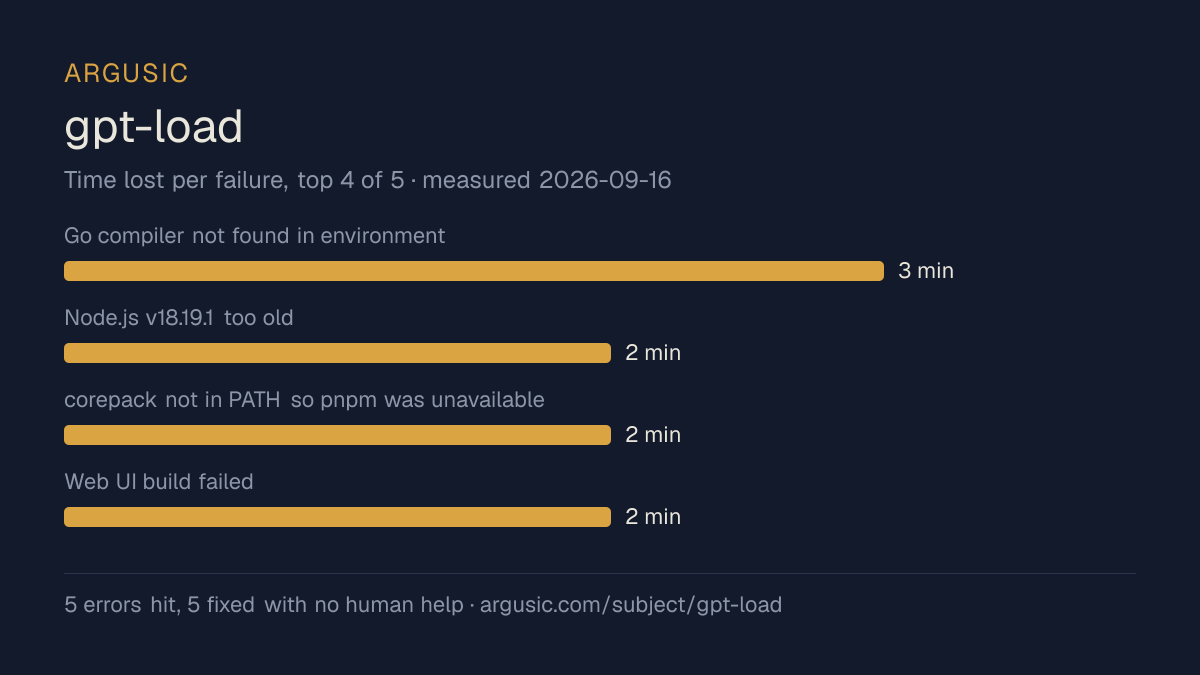
What went wrong, in the agent's own words
The agent's own words, worst first, never rewritten into advice.
- Go 1.27 not pre-installed in container2 minutes
- Node.js v18.19.1 too old (requires >=24.11.0), pnpm not installed2 minutes
- 6 tests fail in internal/webui (container_contract_test.go) - docker not found in PATH1 minute
- Install time
- 10 minutes
- Cold machine to finish
- 8 minutes
- Errors hit and fixed
- 3 hit, 3 fixed with no human help
- How the result was proved
- curl -s -o /dev/null -w '%{http_code}' http://127.0.0.1:3001/health returned HTTP 200; go test had 59 passed / 6 docker-skipped; binary built at 123MB; logs show clean startup and graceful shutdown
- Model tokens used
- 35,215
- Exact commit tested
- ae59a0ae8515
- Container image
- sha256:cdd920bce783
What was not measured
The other half, so you can see exactly how far this evidence goes. A gap is printed as a gap and never filled in.
- Peak GPU memory
- this ran on a CPU machine, so there was no GPU to sample
- Behaviour over a long run
- each attempt uses the smallest documented settings and a fixed time budget, so this measures whether it runs, not how it holds up under load
Watch the session
The whole run, from a clean machine, at the speed it actually happened. Nothing is cut and nothing is sped up.
A recording of attempt 2, run . The verdict above comes from a different attempt, so read this as one session and not as the current result. The terminal recording it was made from is the evidence, stored with a sha256 fingerprint; the video is a rendering of it. Nothing loads from the video host until you press play.
The end of the recording
The last lines of the terminal session that decided this verdict, exactly as they were recorded.
All done. Here's the summary:
**Install**: Go 1.27.1 and Node 24.11.0 were not pre-installed — downloaded both and set them up al…
**Launch**: `./gpt-load` starts cleanly, binds to `127.0.0.1:3001`, returns `HTTP 200` on `/health`…
**Tests**: 59 of 65 test packages pass. The 6 failing tests in `internal/webui` (`container_contrac…
**Result printed above as a single JSON line.**
tokens used
35,215
All done. Here's the summary:
**Install**: Go 1.27.1 and Node 24.11.0 were not pre-installed — downloaded both and set them up al…
**Launch**: `./gpt-load` starts cleanly, binds to `127.0.0.1:3001`, returns `HTTP 200` on `/health`…
**Tests**: 59 of 65 test packages pass. The 6 failing tests in `internal/webui` (`container_contrac…
**Result printed above as a single JSON line.**
Replay the whole session, every command from a clean machine to this point.
How it was tested
One agent, one container, no human help. It installs the project the way its own documentation says to, runs it, and fixes what breaks. Everything below is recorded as it happened: the terminal session, the log and the exact commit. The full method.
Strengths and limits
Measured facts, not opinions. How this is written.
What went well
- Reached a running state on a clean machine, with the session recorded.
- Installed in 10 minutes, faster than the median of the 22 comparable projects Argusic has measured.
- Recovered from all 3 errors without a human stepping in, which says the failures are documented well enough to solve.
- Ran without a GPU, so it does not need one to start.
- Licensed MIT, as reported by its host.
- Measured 3 times, so the result is not a one-off.
Of the 23 ai-gateway projects Argusic has installed and timed, gpt-load was the 10th fastest to reach a running state, and 17 of 23 reached one at all.
What it is a reasonable choice for
- Trying it on a laptop or a small server: it reached a running state without a GPU.
- A quick evaluation: it was running 10 minutes after the clone.
Also tested, in the same area
Every one of these was installed and run by Argusic on a clean machine. Nothing appears here that was not tested.
Run history
Topics (from GitHub)
ai-gatewayanthropicapi-gatewayclaudeclaude-codecodexgeminigingogolangllmllm-gatewayload-balanceropenaiself-hosted
Embed the badge
Markdown for the project README. It links back here; terms on the terms page.
[](https://argusic.com/subject/gpt-load)Questions
- Does gpt-load run?
- Yes. gpt-load runs. Argusic installed and launched it on a clean machine in 10 minutes, hitting 3 errors on the way, and recorded the session.
- How did Argusic test gpt-load?
- On a fresh, disposable machine, with every command recorded and the repository pinned at commit ae59a0ae8515. 3 attempts are recorded, and the full method is on the methodology page.
- What did it cost to test gpt-load?
- The run that produced this verdict cost $0.03: real compute and model cost, not a list price per million tokens. It is recorded on that run's page.
- How long does gpt-load take to install?
- 10 minutes in the run that decided this verdict, from a clean machine to a running state. That is one measured attempt, not an average.
- Does gpt-load need a GPU?
- Not to start. Argusic reached a running state on a machine with no GPU.
- What goes wrong when installing gpt-load?
- 3 things broke in the recorded run, and 3 were fixed without human help. Each one, and the time it cost, is listed on this page.
- How does gpt-load compare with the alternatives?
- Of the 23 ai-gateway projects Argusic has installed and timed, gpt-load was the 10th fastest to reach a running state, and 17 of 23 reached one at all.
- Where is the evidence for gpt-load?
- All 3 recorded runs are on this page, each linking to its full log and terminal recording, stored with a sha256 fingerprint so it cannot be quietly altered.