Gladys
A privacy-first, open-source home assistant
Runssource: GitHubhomepageJavaScriptApache-2.0commit 8574722f2ffb
JavaScript, Apache-2.0 licensed. The project labels itself: assistant, automation, gladys, home, home automation, iot, nodejs and raspberry pi.
Gladys runs. An Argusic agent installed it in 3 minutes and hit 7 errors and fixed every one without help on a clean machine with no GPU, and the whole session was recorded.
Server builds, starts, listens on port 1443, runs migrations, serves API, and passes 6264/6274 server tests. 9 tests fail due to missing sqlite3 CLI, Docker, and Gladys Plus gateway, all environmental.
What the agent ended up with on a clean machine, in its own words. How this is measured
Measured by Argusic on a fresh machine every time. Every number links to its evidence. Argusic Score 100 of 100 (the mean of this project's run scores).
At a glance
Subject data from GitHub, linked at the top of this page, refreshed . Test data by Argusic (CC BY 4.0); every number links to a run page with the full log, the recording, and their sha256 hashes.
What was measured
From the run that decided this verdict. Every line is a recorded value, not an estimate.
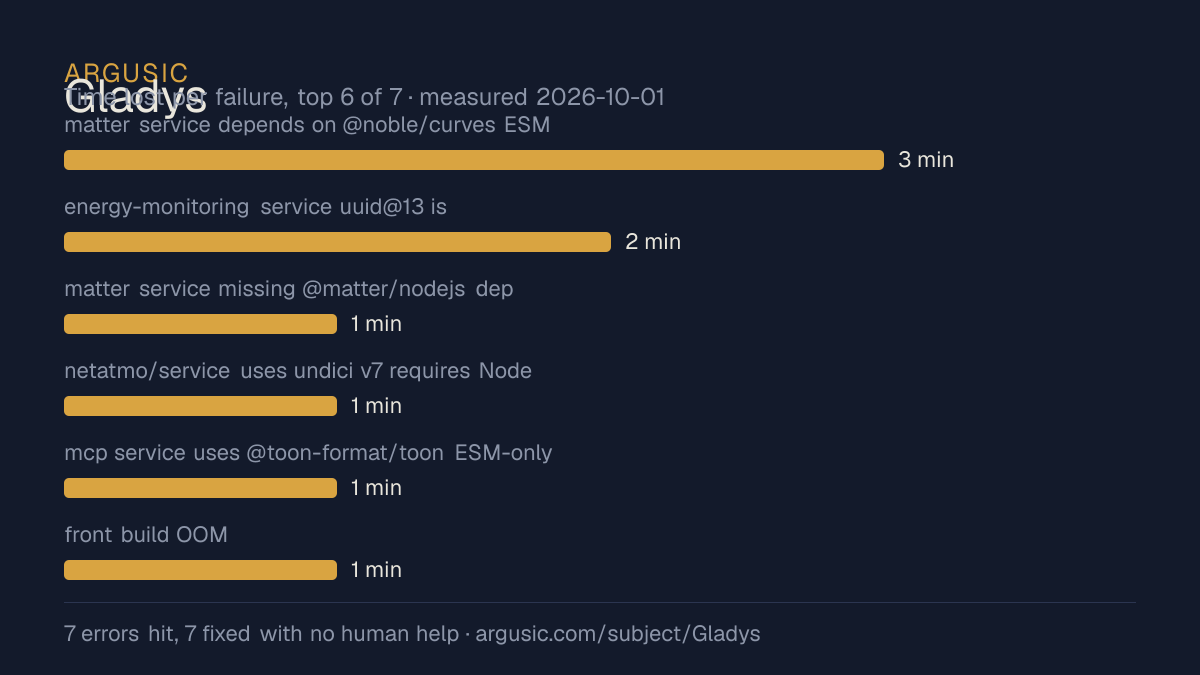
What went wrong, in the agent's own words
The agent's own words, worst first, never rewritten into advice.
- matter service depends on @noble/curves ESM, crashes Node 183 minutes
- energy-monitoring service uuid@13 is ESM-only, breaking require()2 minutes
- matter service missing @matter/nodejs dep1 minute
- netatmo/service uses undici v7 requires Node 20+1 minute
- mcp service uses @toon-format/toon ESM-only, breaks Node 181 minute
- front build OOM1 minute
- Install time
- 3 minutes
- Cold machine to finish
- 83 minutes
- Errors hit and fixed
- 7 hit, 7 fixed with no human help
- How the result was proved
- npm test-serial: 6264 passing, 9 failing (env only); curl http://localhost:1443/api/v1/ping -> 200
- Model tokens used
- 695,100
- Exact commit tested
- 8574722f2ffb
- Container image
- sha256:cdd920bce783
What was not measured
The other half, so you can see exactly how far this evidence goes. A gap is printed as a gap and never filled in.
- Peak GPU memory
- this ran on a CPU machine, so there was no GPU to sample
- Behaviour over a long run
- each attempt uses the smallest documented settings and a fixed time budget, so this measures whether it runs, not how it holds up under load
The end of the recording
The last lines of the terminal session that decided this verdict, exactly as they were recorded.
5. **Known environment limitations** (not repairable without root/upgrades):
   - Node 18 vs required 24.x — many ESM-dependent packages fail
   - Missing `sqlite3` CLI binary — backup/restore tests can't run
   - No Docker daemon — container-dependent integration tests skip
   - Frontend Vite build OOM — container has limited RAM
6. **Frontend** — `npm install` succeeded. Build is OOM-limited in this container.
exec
/bin/sh -lc "echo '{\"install_succeeded\": true, \"launch_succeeded\": true, \"install_minutes\": 3…
 succeeded in 0ms:
{"install_succeeded": true, "launch_succeeded": true, "install_minutes": 3, "errors": [{"msg": "ene…
tokens used
695,100
Replay the whole session, every command from a clean machine to this point.
How it was tested
One agent, one container, no human help. It installs the project the way its own documentation says to, runs it, and fixes what breaks. Everything below is recorded as it happened: the terminal session, the log and the exact commit. The full method.
Strengths and limits
Measured facts, not opinions. How this is written.
What went well
- Reached a running state on a clean machine, with the session recorded.
- Installed in 3 minutes.
- Recovered from all 7 errors without a human stepping in, which says the failures are documented well enough to solve.
- Ran without a GPU, so it does not need one to start.
- Licensed Apache-2.0, as reported by its host.
What did not, or is not known
- Measured once so far. A single attempt shows it can run, not that it runs reliably.
What it is a reasonable choice for
- Trying it on a laptop or a small server: it reached a running state without a GPU.
- A quick evaluation: it was running 3 minutes after the clone.
Also tested, in the same area
Every one of these was installed and run by Argusic on a clean machine. Nothing appears here that was not tested.
Run history
Topics (from GitHub)
assistantautomationgladyshomehome-automationiotnodejsraspberry-pismarthome
Embed the badge
Markdown for the project README. It links back here; terms on the terms page.
[](https://argusic.com/subject/gladys)Questions
- Does Gladys run?
- Yes. Gladys runs. Argusic installed and launched it on a clean machine in 3 minutes, hitting 7 errors on the way, and recorded the session.
- How did Argusic test Gladys?
- On a fresh, disposable machine, with every command recorded and the repository pinned at commit 8574722f2ffb. One attempt is recorded, and the full method is on the methodology page.
- What did it cost to test Gladys?
- The run that produced this verdict cost $0.30: real compute and model cost, not a list price per million tokens. It is recorded on that run's page.
- How long does Gladys take to install?
- 3 minutes in the run that decided this verdict, from a clean machine to a running state. That is one measured attempt, not an average.
- Does Gladys need a GPU?
- Not to start. Argusic reached a running state on a machine with no GPU.
- What goes wrong when installing Gladys?
- 7 things broke in the recorded run, and 7 were fixed without human help. Each one, and the time it cost, is listed on this page.
- Where is the evidence for Gladys?
- The recorded run is on this page, each linking to its full log and terminal recording, stored with a sha256 fingerprint so it cannot be quietly altered.