fn-knock-turborepo
面向 NAS、软路由与家庭服务器的多平台高性能安全网关,采用 Rust + Go 双核心架构,集成反向代理、身份认证、WAF、SSL、DDNS 与内网穿透。
Runssource: GitHubRustMITcommit c9e44e1f1428
Rust, MIT licensed. The project labels itself: access control, authentication, fn knock, fnos, golang, reverse proxy, rust and self hosted.
fn-knock-turborepo runs. An Argusic agent installed it in 15 minutes and hit 12 errors on a clean machine with no GPU, and the whole session was recorded.
The repository installs and builds with Node 22.22.3, npm 10.8.2, Rust 1.96.0, and Go 1.26.10, and its real Rust/Go runtime passed browser setup/login, configuration, Host mapping, backup restore, auth-asset, and cross-domain single-service authentication flows.
What the agent ended up with on a clean machine, in its own words. How this is measured
Measured by Argusic on a fresh machine every time. Every number links to its evidence. Argusic Score 93.3 of 100 (the mean of this project's run scores).
At a glance
Subject data from GitHub, linked at the top of this page. Test data by Argusic (CC BY 4.0); every number links to a run page with the full log, the recording, and their sha256 hashes.
What was measured
From the run that decided this verdict. Every line is a recorded value, not an estimate.
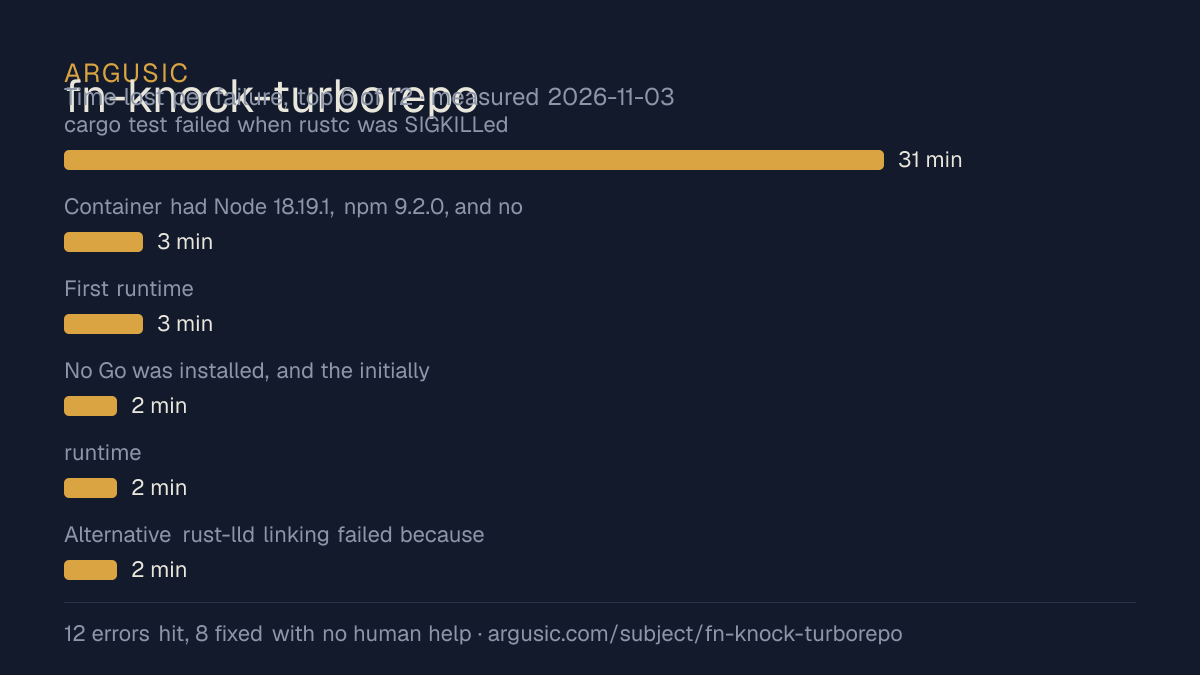
What went wrong, in the agent's own words
The agent's own words, worst first, never rewritten into advice.
- cargo test failed when rustc was SIGKILLed while linking the lib-test binary; serial --jobs 1 retry was also SIGKILLed at about 6.3 GB RSS.31 minutes
- Container had Node 18.19.1, npm 9.2.0, and no Rust toolchain; README requires Node 22.12+, npm 10.8.2, and Rust 1.96.0.3 minutes
- First runtime:auth-single-service attempt timed out with HTTP 503 from /__fn-knock/readyz during heavy Rust compilation.3 minutes
- No Go was installed, and the initially installed Go 1.24.6 was below the pinned gateway go.mod requirement of Go 1.26.10.2 minutes
- runtime:auth-assets and runtime:auth-single-service could not find the gateway because the shared harness ignored FN_KNOCK_RUNTIME_E2E_GATEWAY_BIN.2 minutes
- Alternative rust-lld linking failed because the linker could not find libc or GCC runtime libraries.2 minutes
- Install time
- 15 minutes
- Cold machine to finish
- 46 minutes
- Errors hit and fixed
- 12 hit, 8 fixed with no human help
- How the result was proved
- npm ci exited 0; npm run build exited 0 with 4/4 Turbo tasks in 11m31s; npm run runtime:e2e exited 0 and passed protected setup/login, config save, Host mapping update, and backup restore; runtime:auth-assets exited 0 with 11 PASS checks; runtime:auth-single-service exited 0 with 9 PASS checks; frontend tests exited 0 with 889 Node/TAP and 560 Vitest tests passed; Go suite passed 21 packages while the isolated `::1` test failed with OSError 99; built Rust unit binary passed 1/1.
- Model tokens used
- 962,790
- Exact commit tested
- c9e44e1f1428
- Container image
- sha256:cdd920bce783
What was not measured
The other half, so you can see exactly how far this evidence goes. A gap is printed as a gap and never filled in.
- Peak GPU memory
- this ran on a CPU machine, so there was no GPU to sample
- Behaviour over a long run
- each attempt uses the smallest documented settings and a fixed time budget, so this measures whether it runs, not how it holds up under load
The end of the recording
The last lines of the terminal session that decided this verdict, exactly as they were recorded.
ok    go-reauth-proxy/pkg/middleware  0.006s
ok    go-reauth-proxy/pkg/models  0.012s
ok    go-reauth-proxy/pkg/response  0.571s
ok    go-reauth-proxy/pkg/rpcbridge  0.249s
ok    go-reauth-proxy/pkg/staticserve  2.007s
ok    go-reauth-proxy/pkg/stream  0.478s
ok    go-reauth-proxy/pkg/streamprobe  3.549s
ok    go-reauth-proxy/pkg/waf  0.433s
ok    go-reauth-proxy/cmd/server  3.486s
EXIT=0
tokens used
962,790
Replay the whole session, every command from a clean machine to this point.
How it was tested
One agent, one container, no human help. It installs the project the way its own documentation says to, runs it, and fixes what breaks. Everything below is recorded as it happened: the terminal session, the log and the exact commit. The full method.
Strengths and limits
Measured facts, not opinions. How this is written.
What went well
- Reached a running state on a clean machine, with the session recorded.
- Installed in 15 minutes.
- Ran without a GPU, so it does not need one to start.
- Licensed MIT, as reported by its host.
What did not, or is not known
- Hit 12 errors during setup, 4 of which were not solved.
- Measured once so far. A single attempt shows it can run, not that it runs reliably.
What it is a reasonable choice for
- Trying it on a laptop or a small server: it reached a running state without a GPU.
Also tested, in the same area
Every one of these was installed and run by Argusic on a clean machine. Nothing appears here that was not tested.
Run history
Topics (from GitHub)
access-controlauthenticationfn-knockfnosgolangreverse-proxyrustself-hostedzero-trust
Embed the badge
Markdown for the project README. It links back here; terms on the terms page.
[](https://argusic.com/subject/fn-knock-turborepo)Questions
- Does fn-knock-turborepo run?
- Yes. fn-knock-turborepo runs. Argusic installed and launched it on a clean machine in 15 minutes, hitting 12 errors on the way, and recorded the session.
- How did Argusic test fn-knock-turborepo?
- On a fresh, disposable machine, with every command recorded and the repository pinned at commit c9e44e1f1428. One attempt is recorded, and the full method is on the methodology page.
- What did it cost to test fn-knock-turborepo?
- The run that produced this verdict cost $0.60: real compute and model cost, not a list price per million tokens. It is recorded on that run's page.
- How long does fn-knock-turborepo take to install?
- 15 minutes in the run that decided this verdict, from a clean machine to a running state. That is one measured attempt, not an average.
- Does fn-knock-turborepo need a GPU?
- Not to start. Argusic reached a running state on a machine with no GPU.
- What goes wrong when installing fn-knock-turborepo?
- 12 things broke in the recorded run, and 8 were fixed without human help. Each one, and the time it cost, is listed on this page.
- Where is the evidence for fn-knock-turborepo?
- The recorded run is on this page, each linking to its full log and terminal recording, stored with a sha256 fingerprint so it cannot be quietly altered.