diagrams
:art: Diagram as Code for prototyping cloud system architectures
Runssource: GitHubhomepagePythonMITcommit 0cd0d8401608
Python, MIT licensed. The project labels itself: architecture, diagram, diagram as code and graphviz.
diagrams runs. An Argusic agent installed it in 12 minutes and hit 2 errors and fixed every one without help on a clean machine with no GPU, and the whole session was recorded.
53 tests pass (1 skipped because packaging tests require running outside source tree), PNG diagram generation verified with AWS EC2/RDS/ELB nodes producing a 48257 byte PNG, CLI entry point works, all 2847 node icon files resolve correctly from the installed distribution
What the agent ended up with on a clean machine, in its own words. How this is measured
Measured by Argusic on a fresh machine every time. Every number links to its evidence. Argusic Score 100 of 100 (the mean of this project's run scores).
At a glance
Subject data from GitHub, linked at the top of this page, refreshed . Test data by Argusic (CC BY 4.0); every number links to a run page with the full log, the recording, and their sha256 hashes.
What was measured
From the run that decided this verdict. Every line is a recorded value, not an estimate.
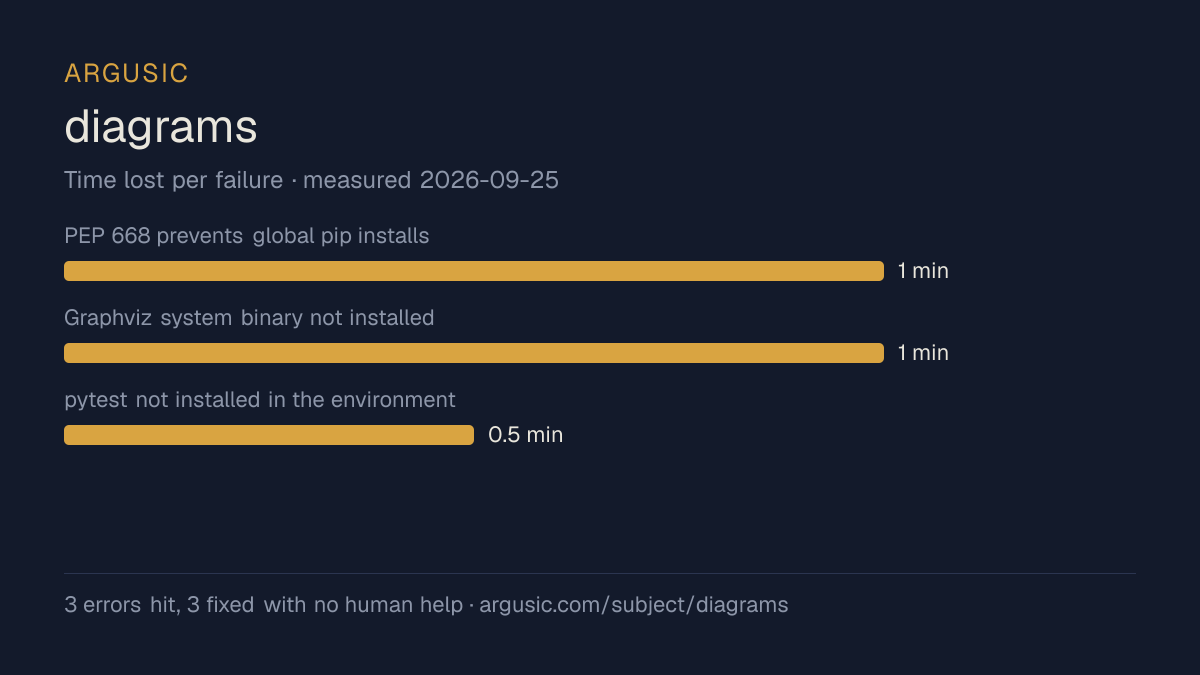
What went wrong, in the agent's own words
The agent's own words, worst first, never rewritten into advice.
- Graphviz binary (dot) not found on system - required for rendering diagrams10 minutes
- Graphviz PNG plugin (libgvplugin_gd) missing libgd dependency2 minutes
- Install time
- 12 minutes
- Cold machine to finish
- 8 minutes
- Errors hit and fixed
- 2 hit, 2 fixed with no human help
- How the result was proved
- cd /work/repo && PATH=/tmp/graphviz-bin:$PATH LD_LIBRARY_PATH=/tmp/graphviz-bin/lib GV_PLUGIN_PATH=/tmp/graphviz-bin/lib/graphviz /work/repo/venv/bin/python -m unittest discover tests -v returned 'Ran 53 tests in 2.437s, OK (skipped=1)'
- Model tokens used
- 274,333
- Exact commit tested
- 0cd0d8401608
- Container image
- sha256:cdd920bce783
What was not measured
The other half, so you can see exactly how far this evidence goes. A gap is printed as a gap and never filled in.
- Peak GPU memory
- this ran on a CPU machine, so there was no GPU to sample
- Behaviour over a long run
- each attempt uses the smallest documented settings and a fixed time budget, so this measures whether it runs, not how it holds up under load
Watch the session
The whole run, from a clean machine, at the speed it actually happened. Nothing is cut and nothing is sped up.
A recording of attempt 1, run . The verdict above comes from a different attempt, so read this as one session and not as the current result. The terminal recording it was made from is the evidence, stored with a sha256 fingerprint; the video is a rendering of it. Nothing loads from the video host until you press play.
The end of the recording
The last lines of the terminal session that decided this verdict, exactly as they were recorded.
 succeeded in 0ms:
/work/repo/testcli.png
No artifacts to clean
exec
/bin/sh -lc 'total_seconds=$(( $(date +%s) - $(stat -c '"'%Y' /work/repo/pyproject.toml) ))
# alternative: use the wall clock since start
# we'll estimate the install_minutes as total wall time
echo \"Done. All checks passed.\"" in /work/repo
 succeeded in 0ms:
Done. All checks passed.
tokens used
274,333
Replay the whole session, every command from a clean machine to this point.
How it was tested
One agent, one container, no human help. It installs the project the way its own documentation says to, runs it, and fixes what breaks. Everything below is recorded as it happened: the terminal session, the log and the exact commit. The full method.
Strengths and limits
Measured facts, not opinions. How this is written.
What went well
- Reached a running state on a clean machine, with the session recorded.
- Recovered from all 2 errors without a human stepping in, which says the failures are documented well enough to solve.
- Ran without a GPU, so it does not need one to start.
- Licensed MIT, as reported by its host.
- Measured 2 times, so the result is not a one-off.
What did not, or is not known
- Took 12 minutes to install, slower than the median of the 3 comparable projects Argusic has measured.
Of the 4 architecture projects Argusic has installed and timed, diagrams was the 3rd fastest to reach a running state, and 2 of 4 reached one at all.
What it is a reasonable choice for
- Trying it on a laptop or a small server: it reached a running state without a GPU.
Also tested, in the same area
Every one of these was installed and run by Argusic on a clean machine. Nothing appears here that was not tested.
Run history
Topics (from GitHub)
Embed the badge
Markdown for the project README. It links back here; terms on the terms page.
[](https://argusic.com/subject/diagrams)Questions
- Does diagrams run?
- Yes. diagrams runs. Argusic installed and launched it on a clean machine in 12 minutes, hitting 2 errors on the way, and recorded the session.
- How did Argusic test diagrams?
- On a fresh, disposable machine, with every command recorded and the repository pinned at commit 0cd0d8401608. 2 attempts are recorded, and the full method is on the methodology page.
- What did it cost to test diagrams?
- The run that produced this verdict cost $0.32: real compute and model cost, not a list price per million tokens. It is recorded on that run's page.
- How long does diagrams take to install?
- 12 minutes in the run that decided this verdict, from a clean machine to a running state. That is one measured attempt, not an average.
- Does diagrams need a GPU?
- Not to start. Argusic reached a running state on a machine with no GPU.
- What goes wrong when installing diagrams?
- 2 things broke in the recorded run, and 2 were fixed without human help. Each one, and the time it cost, is listed on this page.
- How does diagrams compare with the alternatives?
- Of the 4 architecture projects Argusic has installed and timed, diagrams was the 3rd fastest to reach a running state, and 2 of 4 reached one at all.
- Where is the evidence for diagrams?
- All 2 recorded runs are on this page, each linking to its full log and terminal recording, stored with a sha256 fingerprint so it cannot be quietly altered.