Self-hosted Notion alternatives, checked by a real install
Notes, docs, and wikis that live on your own server. Argusic performed a first-time setup of each one and recorded whether it launched; the ranking reflects that measurement, and the date of each test sits next to the verdict.
Tested between and . Each row shows its own test date; a project can change after that day.
8 of 8 tested projects run. 1 more waiting for a test.
In short: 7 of the 8 tested projects started as-is on a fresh machine: memos, colanode, NoteDiscovery, leafwiki, many-notes, poznote, and scoold. 1 more started once a stand-in replaced a service it expects, such as a database: docs.
Measured by Argusic on a fresh machine every time. Every number links to its evidence.
| # | project | verdict | Argusic Score | language | stars | tested on |
|---|---|---|---|---|---|---|
| 1 | memos | Runs | 100 / 100 | Go | 63,616 | |
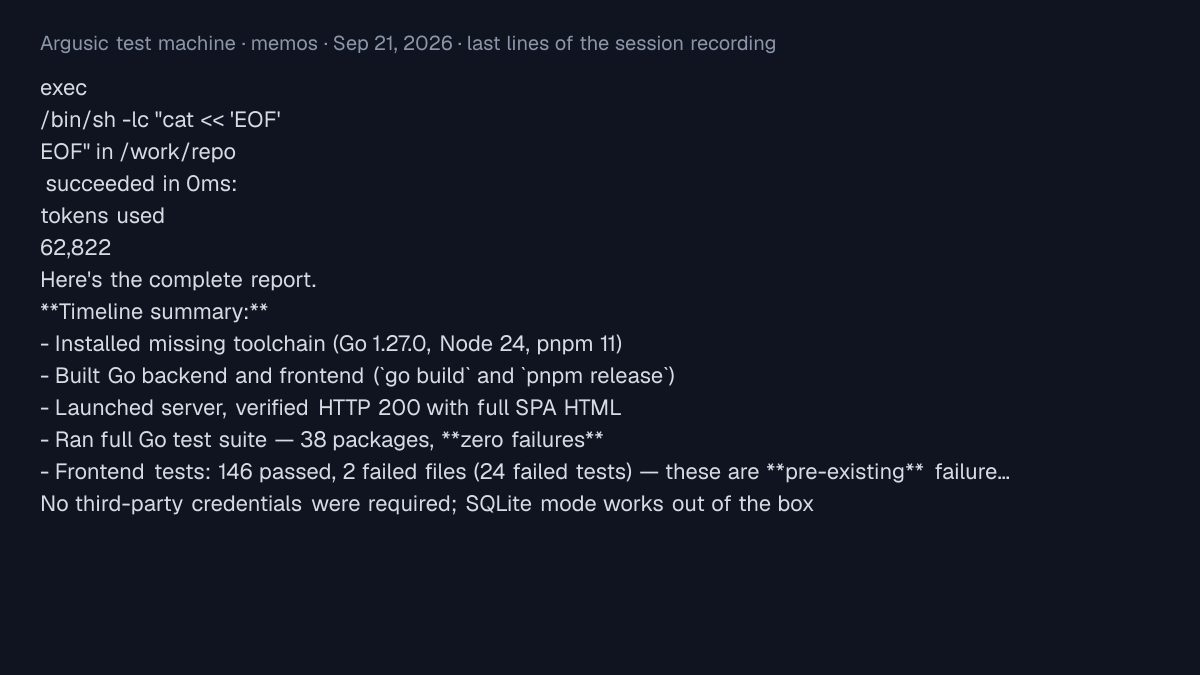
A personal timeline for quick notes. Write short memos, find them later by search, tag, or date. Open source and self-hosted. What the test found: Memos starts with a fresh SQLite database, serves its React SPA on port 8081 with HTTP 200, and all 38 Go packages pass their tests. 24 minutes. | ||||||
| 2 | colanode | Runs | 100 / 100 | TypeScript | 5,163 | |
Open-source and local-first Slack and Notion alternative that puts you in control of your data What the test found: All packages build and type-check; server ES bundle compiles; web app builds and all 133 tests pass. 15 minutes. | ||||||
| 3 | NoteDiscovery | Runs | 100 / 100 | JavaScript | 2,829 | |
Your Self-Hosted Knowledge Base What the test found: NoteDiscovery v0.31.4 server starts on port 8000, serves the web UI, provides a full REST API (notes CRUD, search, tags, themes, templates, sharing), and runs an MCP server with 17 tools for AI assistant integration. 5 minutes. | ||||||
| 4 | leafwiki | Runs | 100 / 100 | Go | 1,173 | |
LeafWiki - Self-hosted wiki. Single Go binary, SQLite, Markdown on disk. No external database required. What the test found: LeafWiki compiles from source, starts on port 8080 with SQLite storage and JWT auth, health API returns 200 OK, admin login succeeds with cookie-based JWT tokens, page tree is readable, pages can be created/read/updated via the API, and the full Go test suite (48 packages) passes with zero failures. 12 minutes. | ||||||
| 5 | many-notes | Runs | 100 / 100 | PHP | 1,093 | |
Markdown note-taking web application designed for simplicity What the test found: PHP 8.4.23 static binary installed, Composer deps resolved, Node 26 frontend built, SQLite database migrated, and Pest test suite 179/179 passes verifying all Feature and Unit tests. 27 minutes. | ||||||
| 6 | poznote | Runs | 86 / 100 | JavaScript | 916 | |
Powerful note-taking without the hassle. What the test found: Poznote v6.72.0 PHP application runs on static PHP 8.3 via built-in server; SQLite master and user databases initialized; full REST API v1 test suite (81 tests) passes; login page serves correctly. 36 minutes. | ||||||
| 7 | scoold | Runs | 60 / 100 | Java | 923 | |
The Stack Overflow clone for your team (self-hosted or hosted) What the test found: Scoold 1.70.1 builds successfully (113/113 unit tests pass) and launches connected to a Para 1.55.2 backend with H2 in-memory database, serving the web UI on port 8000. 35 minutes. | ||||||
| 8 | docs | Runs with mocks | 57.3 / 100 | Python | 16,900 | |
Docs is an open-source text editor: web-native, made for real-time collaboration, cleanly structured documents and sub-documents with full ownership of your... What the test found: The Docs backend project installs, builds, and runs 2190+ test cases successfully using mock PostgreSQL, MinIO S3, and compiled email/translation assets, with the only unaddressed failures requiring a real OIDC provider. 62 minutes. | ||||||
| - | myPKA | Not yet tested | - | Python | 305 | - |
runs installed and started with its real dependencies. runs with mocks started after stand-ins replaced external services such as a database or a third-party API. could not verify neither the standard agent nor the stronger one got it running within the time limit; the log shows where it stopped.
Before you choose
Decide what you are willing to run. Five of the seven verified apps are a single process on a local store: memos (Go, SQLite), leafwiki (Go, SQLite), many-notes (PHP, SQLite), poznote (PHP, SQLite), and NoteDiscovery (Python, a plain data directory). scoold started only together with a separate Para backend on an in-memory H2 database, so it is two services, not one.
Check what the test could not cover. colanode's web suite passed 132 of 133 tests, but its server suite needs Docker, which the test machine does not provide, so that part is recorded as skipped in the log. No project on this list needed a stand-in service; every verified app is "runs", not "runs with mocks".
Look at the minutes. NoteDiscovery was up in 8, leafwiki in 13, many-notes in 19; memos, colanode, scoold, and poznote took 25 to 36, most of it building.
The most-starred project is still waiting: docs has no finished attempt yet and sits unranked as "testing soon". Rank follows measurement, so stars alone place nothing on this list.
How we tested
For a notes, docs, or wiki app, working meant the application started on the clean machine and served its web interface: a login page, the editor, or its API answered over HTTP, and the project's own backend tests ran.
Every project on this list that runs did so with a local store: memos, leafwiki, poznote, many-notes, and NoteDiscovery on SQLite or plain files, scoold against an in-memory H2 database. Front-end test suites that depend on Docker or a browser could not run in the container and are listed as skipped in the logs; colanode is the example, verified through its web tests and server utilities instead.
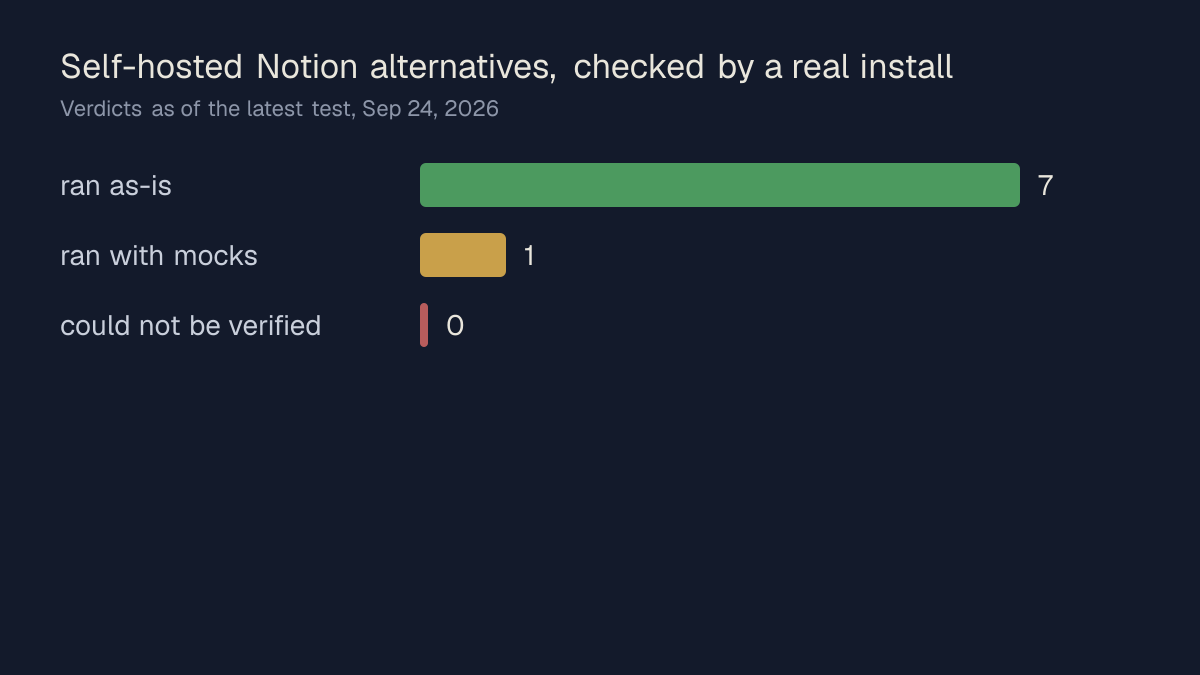
On this list as of the latest test: 7 projects ran as-is, 1 with mocks, 0 could not be verified, 1 still waiting. Languages tested: Go, Java, JavaScript, PHP, Python, TypeScript. Every attempt used a clean single-use machine, the subject at a pinned version, and a 45-minute limit; the complete procedure is on the methodology page.
Frequently asked questions (FAQs)
What does "runs" mean for a notes or wiki app?
The application started on a clean machine and served its web interface, with the project's backend tests run. memos, for example, built, started, served its single-page app, and passed its Go tests.
Does the test cover the editor or collaboration features?
No. Argusic verifies that the software installs and starts and reads what the project's own tests report. Real-time collaboration, sync, and editor quality are not measured, so this list ranks what runs, not what feels best.
Which storage did the projects use in the test?
Local stores: SQLite or plain files for memos, leafwiki, poznote, many-notes, and NoteDiscovery; an in-memory H2 database for scoold. None needed a service the agent had to mock.
Why did a front-end test suite get skipped?
Some suites need Docker or a browser, which the container does not provide. colanode is the example: its web tests and server utilities were verified instead, and the log records the skipped part.
How current is this list?
Each row carries its own test date and the page states the window. A project can change after its test; a new attempt replaces the verdict only when it finishes with complete evidence.
How is this list ranked?
By measurement, not opinion: projects Argusic installed and launched on a fresh machine come first, then those that ran with mocks in place of external services, then those it could not verify. Ties go to the Argusic Score, then how popular it is on its own source.
Why are some projects unranked?
1 project is still waiting for a test or for a finished attempt. They are listed without a rank until Argusic has measured them.
More lists in this category
- wikis (shares colanode, docs, leafwiki, many-notes, myPKA, poznote with this list)
- AI agent frameworks
- self-hosted AI apps
- API clients
- API gateways
- CI/CD tools
- CMS platforms
- LLM gateways
- MCP servers
- VPN tools
- backup tools
- browser automation tools
- code editors
- open source coding agents
- Open source databases, installed and queried
- developer CLI tools
- e-commerce platforms
- ebook readers
- game engines
- open source games
- home automation tools
- low-code platforms
- map tools
- message queues
- Open source music servers, installed and played
- observability tools
- Open source office suites, installed and launched
- self-hosted password managers
- project management tools
- screen recorders
- search engines
- self-hosted analytics
- speech tools
- static site generators
- uptime monitors
- vector databases
- open source video editors
- video players
- web scraping tools
- whiteboard tools
- workflow automation tools
- self-hosted dashboards
- self-hosted git servers